
Moons of the Solar System: A Field Guide
Our solar system has hundreds of known moons, most of them small captured rocks. A handful are worlds in their own right, with oceans, volcanoes or atmospheres.
Here are the ten that scientists talk about most, with links to our full guides.
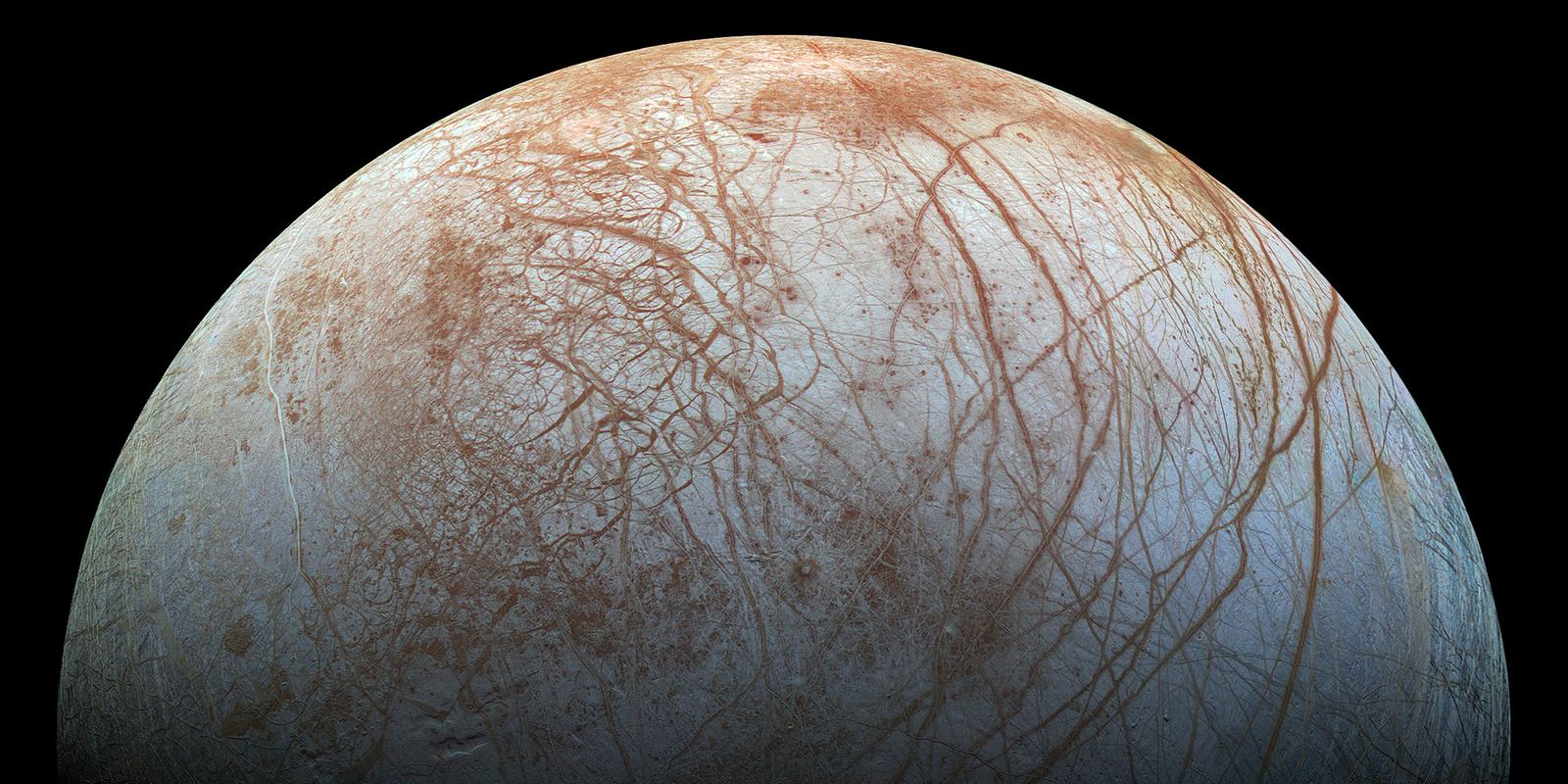
Europa in realistic colour (Galileo): NASA / Jet Propulsion Lab-Caltech / SETI Institute, Public domain
Ten remarkable moons
| Moon | Planet | Diameter (km) | Why it matters |
|---|---|---|---|
| Moon | Earth | 3,475 | The only world beyond Earth where people have walked |
| Phobos | Mars | ~22 (avg) | Spiralling slowly inward toward Mars |
| Io | Jupiter | 3,643 | Most volcanic body in the solar system |
| Europa | Jupiter | 3,122 | Salty ocean under the ice |
| Ganymede | Jupiter | 5,268 | Largest moon, has a magnetic field |
| Callisto | Jupiter | 4,821 | Most heavily cratered surface |
| Titan | Saturn | 5,150 | Thick atmosphere, methane lakes |
| Enceladus | Saturn | ~504 | Water plumes from the south pole |
| Triton | Neptune | 2,707 | Orbits backwards, nitrogen geysers |
| Charon | Pluto | 1,212 | Half Pluto's size; the two orbit a point between them |
Full moon guides
Ocean worlds: Europa, Enceladus, Ganymede and Titan are thought to have liquid water beneath their surfaces, making them top targets in the search for life.
The Planetinio collection
Tees and hoodies in the Planetinio colors, printed to order in the USA. Use code VIP15 from the newsletter for 15% off your first order.





- NASA Science: Our Solar System
- NASA Science: Planetary Fact Sheet (NSSDCA)
- NASA: Moons of the solar system
Facts on this page were checked against these sources (updated Oct 12, 2026). Spot an error? Email hello@fireempireshop.com.