Ganymede
The largest moon in the solar system. Ganymede is bigger than Mercury and the only moon with its own magnetic field. Its hidden ocean, auroras and ESA's JUICE mission explained.
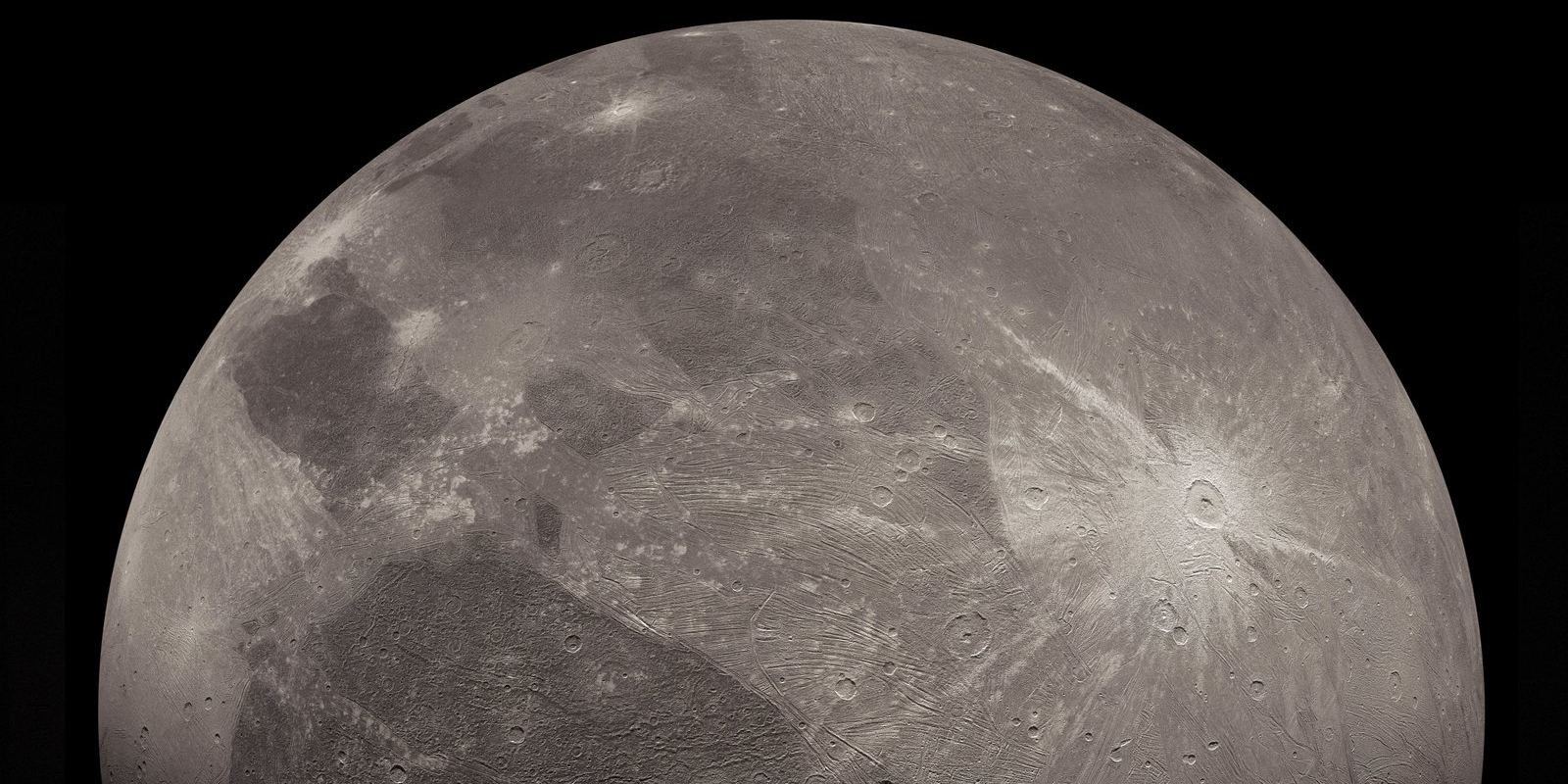
Ganymede seen by Juno: NASA /JPL, Public domain
A moon bigger than a planet
Ganymede is the largest moon in the solar system, about 8 percent wider than the planet Mercury, though only about half as massive because it contains so much ice. Its surface mixes dark, old, heavily cratered regions with lighter areas cut by grooves and ridges, where the icy crust was once stretched and broken.
Magnetic field and auroras
Ganymede is the only moon known to generate its own magnetic field, probably from a liquid iron core. That field creates auroras, glowing bands of light near its poles. Hubble tracked how these auroras rock back and forth, and the pattern gave strong evidence for a salty ocean beneath the surface that dampens the movement.
Scientists think this ocean could be sandwiched between layers of ice, deep below the crust.
Exploring Ganymede
Voyager and Galileo mapped Ganymede, and NASA's Juno flew close by in June 2021, taking the sharpest images in two decades. ESA's JUICE mission, the Jupiter Icy Moons Explorer, launched in April 2023. It is due to reach Jupiter in 2031 and, in 2034, become the first spacecraft to orbit a moon other than our own.
JUICE will measure the ice, map the surface and probe the ocean's depth and saltiness.
Why Ganymede matters
Ganymede shows that ocean worlds may be common in the outer solar system. If its ocean is trapped between ice layers, it may be less friendly to life than Europa's, but studying both helps scientists understand where habitable environments can exist. Ganymede is also a key part of the 1:2:4 orbital rhythm with Io and Europa that drives tidal heating in the Jupiter system.
Seeing it yourself
Ganymede and the other Galilean moons are easy to see with ordinary binoculars when Jupiter is in the night sky. They look like tiny stars lined up beside the planet, and their positions change from night to night as they orbit. Ganymede is usually the brightest of the four. Sketching their positions over a week is a classic beginner project, and it is exactly how Galileo convinced himself in 1610 that they were circling Jupiter rather than Earth.
- Ganymede seen by Juno: NASA /JPL, Public domain
Text written by Planetinio.