
The Planets Compared: Size, Distance, Days and Moons
How big is Jupiter compared with Earth? How long is a day on Venus? This table puts the eight planets side by side using NASA's planetary fact sheet.
Distances are in astronomical units (AU): 1 AU is the average Earth-Sun distance, about 150 million km. Moon counts keep rising as telescopes find small moons, so they are shown as minimums as of 2025.
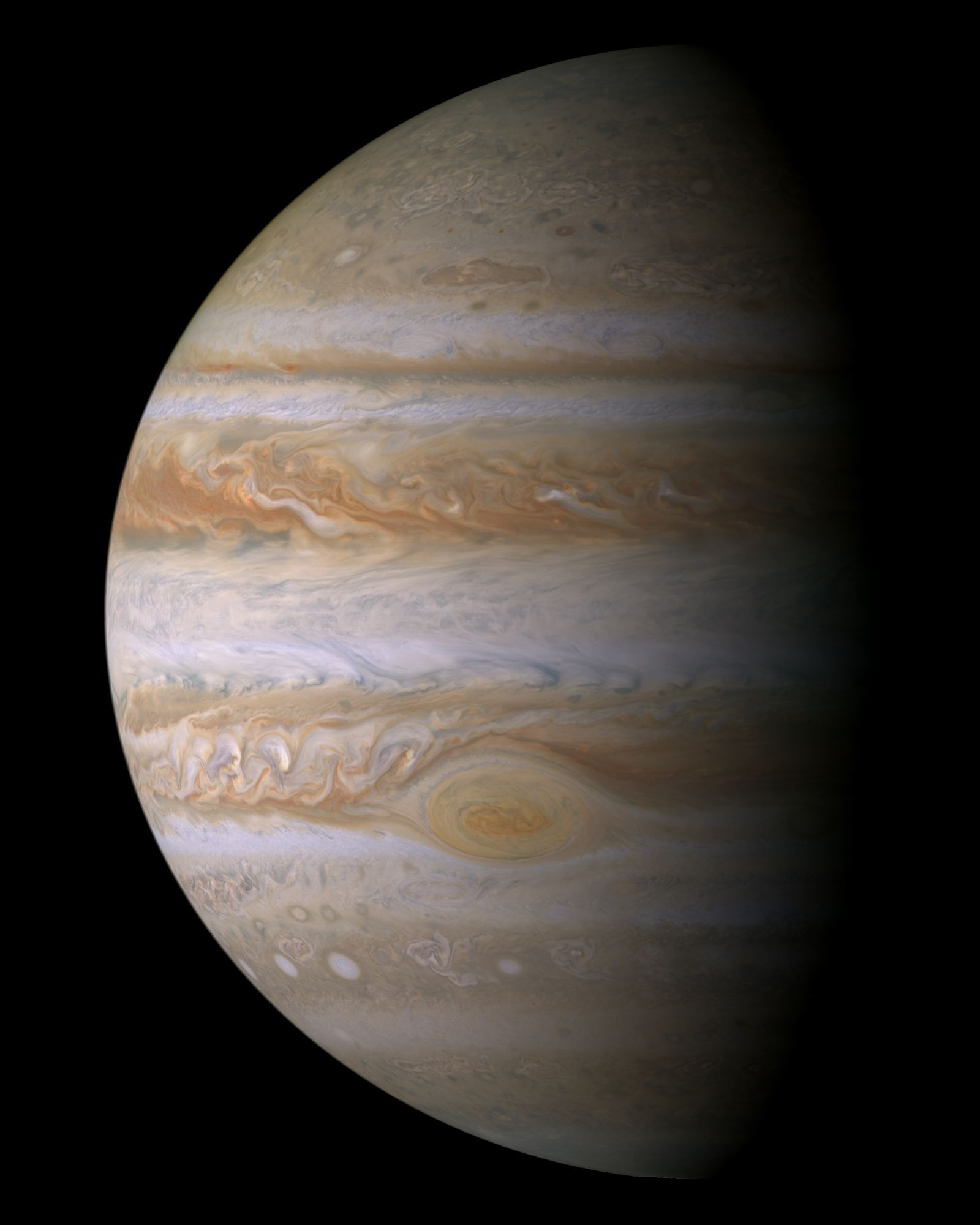
Jupiter portrait from the Cassini spacecraft: NASA/JPL/Space Science Institute, Public domain
The eight planets
| Planet | Diameter (km) | Distance from Sun (AU) | Year | Day (rotation) | Moons | Type |
|---|---|---|---|---|---|---|
| Mercury | 4,879 | 0.39 | 88 days | 58.6 days | 0 | Rocky |
| Venus | 12,104 | 0.72 | 225 days | 243 days (backwards) | 0 | Rocky |
| Earth | 12,756 | 1.00 | 365.25 days | 23.9 hours | 1 | Rocky |
| Mars | 6,792 | 1.52 | 687 days | 24.6 hours | 2 | Rocky |
| Jupiter | 142,984 | 5.20 | 11.9 years | 9.9 hours | 95+ | Gas giant |
| Saturn | 120,536 | 9.54 | 29.4 years | 10.7 hours | 270+ | Gas giant |
| Uranus | 51,118 | 19.2 | 84 years | 17.2 hours (backwards) | 28+ | Ice giant |
| Neptune | 49,528 | 30.1 | 165 years | 16.1 hours | 16 | Ice giant |
Patterns worth noticing
The four inner planets are small and rocky; the four outer planets are giants made mostly of gas and ices. Venus spins backwards and so slowly that its day is longer than its year. Uranus also spins backwards and is tipped on its side, probably after a giant collision long ago.
Jupiter is so large that more than 1,300 Earths could fit inside it, and Saturn is the only planet less dense than water.
Read each planet's guide
The Planetinio collection
Tees and hoodies in the Planetinio colors, printed to order in the USA. Use code VIP15 from the newsletter for 15% off your first order.





- NASA Science: Our Solar System
- NASA Science: Planetary Fact Sheet (NSSDCA)
- NASA: Moons of the solar system
Facts on this page were checked against these sources (updated Oct 12, 2026). Spot an error? Email hello@fireempireshop.com.