Uranus
The ice giant that spins on its side. Uranus is tipped over by about 98 degrees, so its poles take turns facing the Sun for decades. Explore this cold, blue-green ice giant.
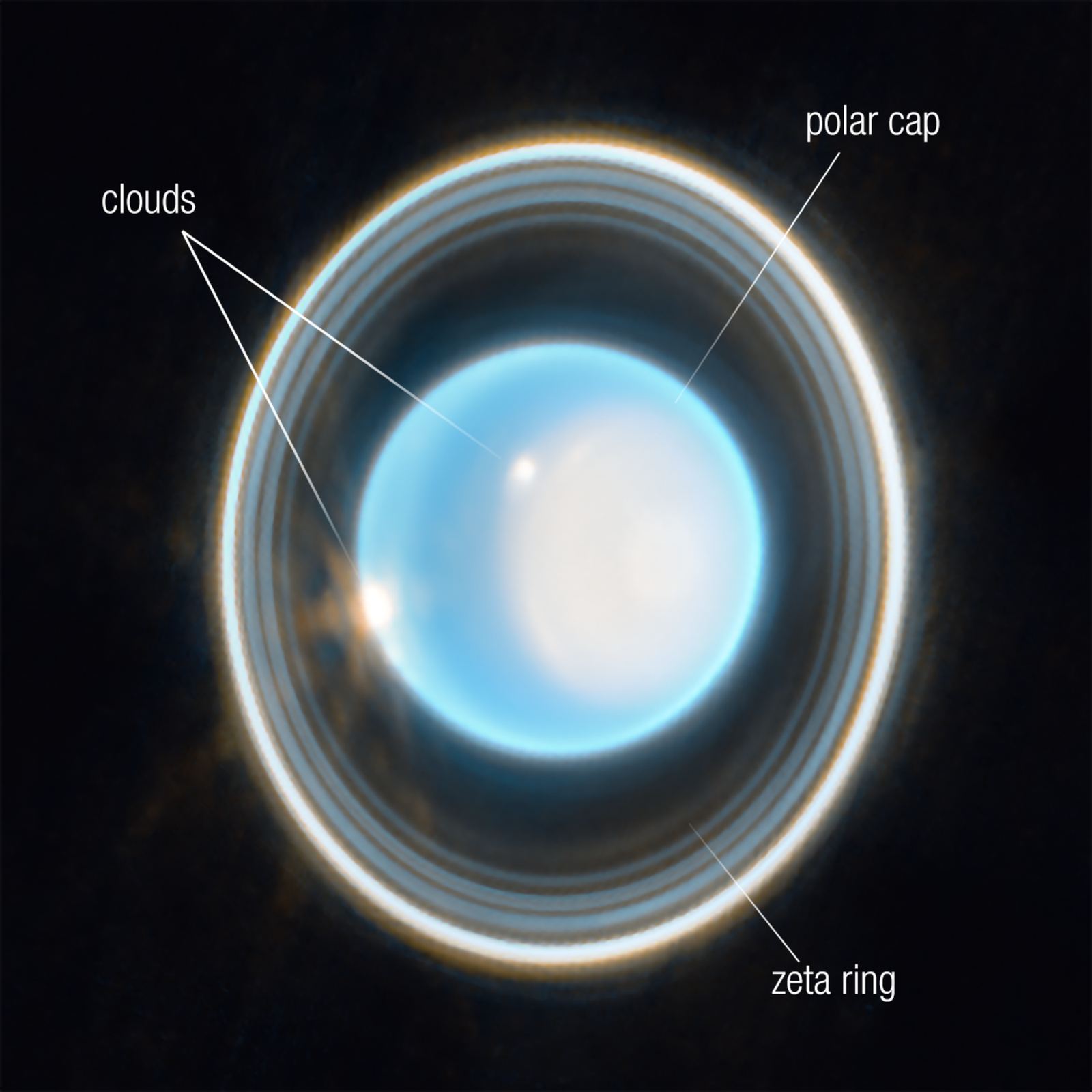
Uranus and its rings from the James Webb Space Telescope: NASA, ESA, CSA, STScI, Public domain
A planet knocked on its side
Most planets spin like tops, roughly upright as they circle the Sun. Uranus rolls around its orbit like a ball, with its axis tilted about 98 degrees. Many scientists think a huge collision early in its history, with a body possibly larger than Earth, knocked it over.
The result is the strangest seasons in the solar system. Uranus takes 84 Earth years to orbit the Sun, so each pole gets about 42 years of continuous sunlight, followed by about 42 years of darkness. Near the solstices, the Sun hangs almost overhead at one pole while the other half of the planet sits in a decades-long night.
Video: Exploring Planet Uranus: Uranus Beauty Pass. Credit: NASA's Goddard Space Flight Center Conceptual Image Lab (source). NASA media; no endorsement implied.
Uranus spins on its side like a rolling ball
Uranus has an axial tilt of about 98 degrees, so each pole gets roughly 42 years of sunlight then 42 years of darkness during its 84-year orbit. Voyager 2 flew past in 1986.
YouTube @Planetinio (launching soon). Photos in this Short: Uranus from Voyager 2.jpg - NASA (Public domain) via Wikimedia Commons | Uranus2.jpg - NASA/JPL-Caltech (Public domain) via Wikimedia Commons | Uranus rings and moons.jpg - Erich Karkoschka (University of Arizona) and NASA/ESA (Public domain) via Wikimedia Commons | Hubble Observes the Planet Uranus (opo9450b).jpg - Kenneth Seidelmann, U.S. Naval Observatory,and NASA/ESA (Public domain) via Wikimedia Commons | Uranus true colour.jpg - NASA/JPLUploaded by nagualdesign (Public domain) via Wikimedi
An ice giant
Uranus and Neptune are called ice giants. Beneath a hydrogen and helium atmosphere, most of their mass is a hot, dense fluid of water, ammonia and methane, the materials astronomers call ices, wrapped around a small rocky core.
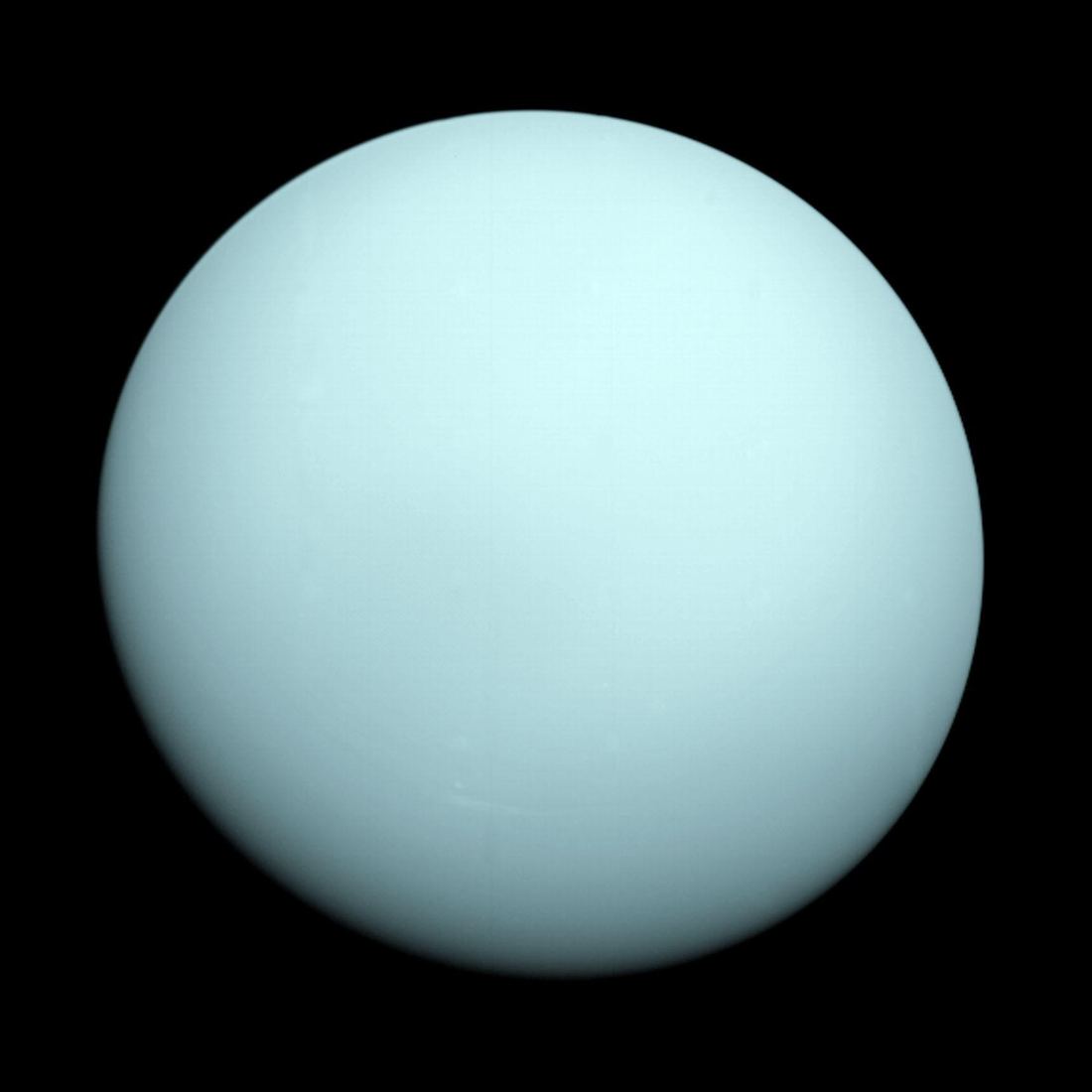
Methane in the upper atmosphere absorbs red light, giving Uranus its soft blue-green color. Despite being closer to the Sun than Neptune, Uranus has recorded the coldest temperatures of any planet, dipping to about -224 °C, likely because it releases very little heat from its interior.
Uranus is the seventh planet from the Sun and the third largest by diameter. Its atmosphere looked almost featureless to Voyager 2, but modern telescopes reveal bright storms, bands of cloud and a hazy cap over the sunlit pole that changes as the planet's long seasons shift.
Rings, moons and Shakespeare
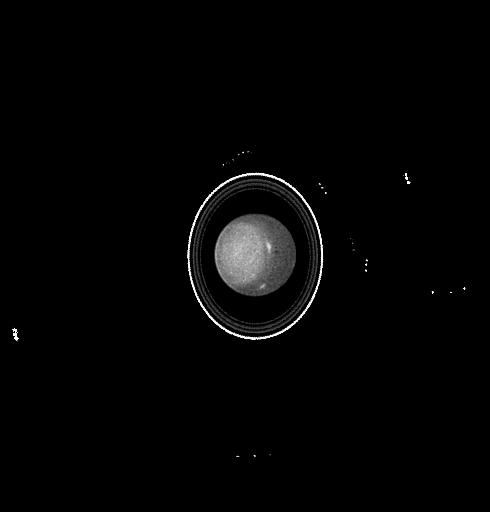
Uranus has 13 known rings, mostly dark and narrow, discovered in 1977 when they blocked the light of a background star. The James Webb Space Telescope now shows them glowing clearly in infrared light.
It also has 29 known moons, most named after characters from Shakespeare and Alexander Pope. Miranda looks like a patchwork world, with cliffs about 20 km tall, among the highest in the solar system. Larger moons such as Titania and Oberon may hide thin oceans beneath their icy crusts.
Uranus also has a magnetic field that is tilted far from its spin axis and offset from the planet's center, so its magnetic environment wobbles wildly as it rotates. Researchers are still puzzling over what deep inside the planet produces such an unusual field.
Visited only once
William Herschel discovered Uranus with a telescope in 1781, the first planet found in modern times. Only one spacecraft has ever visited: Voyager 2 flew past in January 1986, discovering new moons and rings and measuring a lopsided magnetic field.
Much of what we know since comes from Hubble, Webb and large ground-based telescopes. A dedicated orbiter and atmospheric probe have been ranked by planetary scientists as a top priority for a future NASA flagship mission, to finally study this tilted world up close.
Facts on this page were checked against these sources.
- Uranus and its rings from the James Webb Space Telescope: NASA, ESA, CSA, STScI, Public domain
- Uranus seen by Voyager 2: NASA/JPL-Caltech, Public domain
- Hubble view of the rings and moons of Uranus: NASA/JPL/STScI, Public domain
- Video: Exploring Planet Uranus: Uranus Beauty Pass, NASA's Goddard Space Flight Center Conceptual Image Lab, NASA (public domain)
- Short photos: Uranus from Voyager 2.jpg - NASA (Public domain) via Wikimedia Commons | Uranus2.jpg - NASA/JPL-Caltech (Public domain) via Wikimedia Commons | Uranus rings and moons.jpg - Erich Karkoschka (University of Arizona) and NASA/ESA (Public domain) via Wikimedia Commons | Hubble Observes the Planet Uranus (opo9450b).jpg - Kenneth Seidelmann, U.S. Naval Observatory,and NASA/ESA (Public domain) via Wikimedia Commons | Uranus true colour.jpg - NASA/JPLUploaded by nagualdesign (Public domain) via Wikimedia Commons | Uranus from Voyager 2 (1986).jpg - NASA (Public domain) via Wikimedia Commons
Text written by Planetinio.