
Glossary
Space Glossary: 30 Terms Explained Simply
Space news is full of jargon. Here are the terms you will meet most often, explained in plain English.
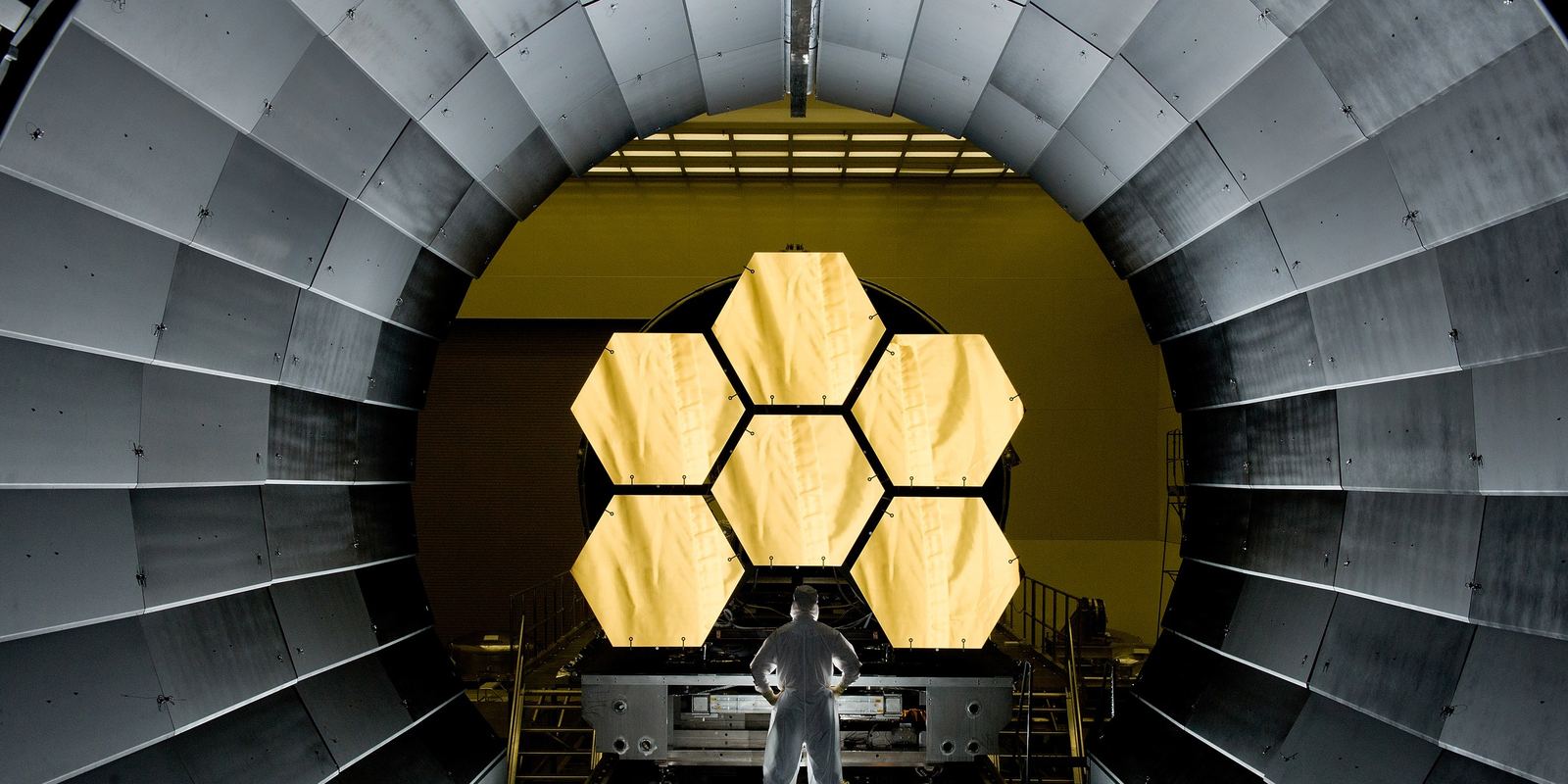
Webb's primary mirror being tested: NASA/MSFC/David Higginbotham, Public domain
| Term | Meaning |
|---|---|
| Astronomical unit (AU) | The average distance from Earth to the Sun, about 150 million km. |
| Light-year | The distance light travels in a year, about 9.46 trillion km. It measures distance, not time. |
| Orbit | The curved path of one object around another, shaped by gravity. |
| Perihelion / aphelion | The closest and farthest points of an orbit around the Sun. |
| Perigee / apogee | The closest and farthest points of an orbit around Earth. |
| Gravity assist | Using a planet's gravity to change a spacecraft's speed and direction without fuel. |
| Dwarf planet | A round body orbiting the Sun that has not cleared its orbital neighbourhood, like Pluto or Ceres. |
| Moon (natural satellite) | A natural body that orbits a planet or other object. |
| Asteroid | A small rocky or metallic body orbiting the Sun, mostly in the main belt. |
| Comet | An icy body that releases gas and dust, forming a coma and tails, near the Sun. |
| Meteor / meteorite | A meteor is the streak of light from space debris burning up; a meteorite is a piece that reaches the ground. |
| Kuiper Belt | A region of icy bodies beyond Neptune, including Pluto. |
| Oort Cloud | A vast, distant shell of icy bodies thought to surround the solar system; source of long-period comets. |
| Heliopause | The boundary where the Sun's solar wind meets interstellar space. |
| Solar wind | A stream of charged particles flowing out from the Sun. |
| Corona | The Sun's hot outer atmosphere, visible during a total solar eclipse. |
| Exoplanet | A planet orbiting a star other than the Sun. |
| Habitable zone | The range of distances from a star where liquid water could exist on a planet's surface. |
| Tidal heating | Heat produced inside a moon or planet as gravity repeatedly flexes it. |
| Tidally locked | When an object always shows the same face to the body it orbits, like our Moon. |
| Retrograde | Moving or spinning in the opposite direction to most objects in the solar system. |
| Lagrange point | A spot where gravity from two large bodies balances, letting a spacecraft hold position, like Webb at L2. |
| Rover / lander / orbiter | A rover drives on a surface, a lander stays where it lands, an orbiter circles a world. |
| Flyby | A mission that passes a world without stopping or orbiting. |
| Sample return | A mission that collects material and brings it back to Earth. |
| Equinox / solstice | Equinoxes have roughly equal day and night; solstices are the longest and shortest days. |
| Eclipse | When one body moves into the shadow of another, like the Moon blocking the Sun. |
| Magnitude | A measure of brightness; smaller numbers mean brighter objects. |
| Biosignature | A sign that could indicate past or present life, needing careful confirmation. |
| Cryovolcano | An ice volcano that erupts water, ammonia or methane instead of molten rock. |
Shop
The Planetinio collection
Tees and hoodies in the Planetinio colors, printed to order in the USA. Use code VIP15 from the newsletter for 15% off your first order.




Sources
- NASA Science: Our Solar System
- NASA Science: Planetary Fact Sheet (NSSDCA)
- NASA: Moons of the solar system
Facts on this page were checked against these sources (updated Oct 12, 2026). Spot an error? Email hello@fireempireshop.com.