Europa
An ocean under the ice. Jupiter's moon Europa hides a salty ocean beneath its icy shell, one of the best places to look for life. Facts, cracks and the Europa Clipper mission.
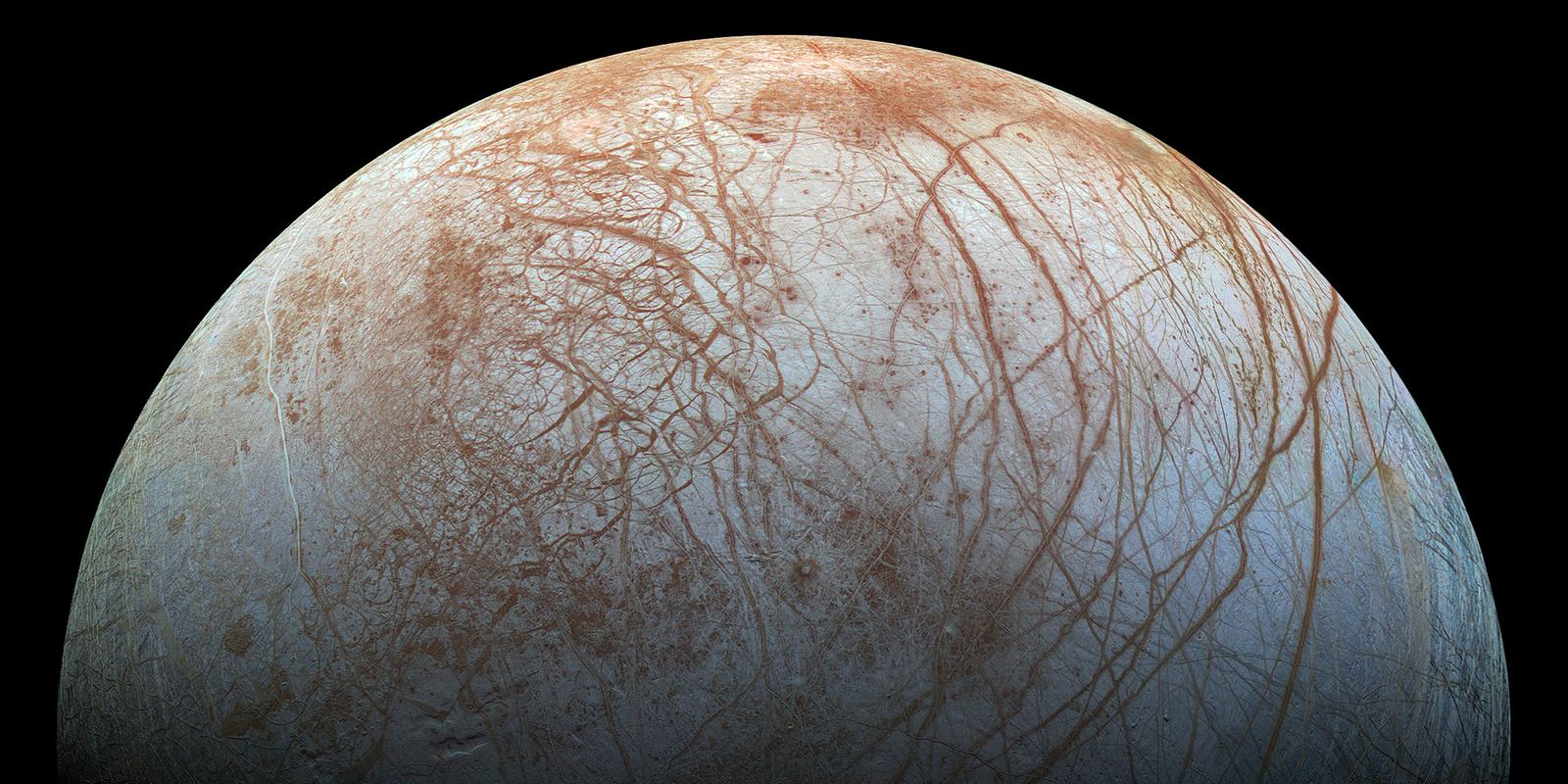
Europa in realistic colour (Galileo): NASA / Jet Propulsion Lab-Caltech / SETI Institute, Public domain
An icy ball with a hidden sea
Europa is a little smaller than our Moon, and its surface is one of the smoothest in the solar system: bright water ice crossed by long reddish-brown cracks and ridges, with few craters. That youthful look tells scientists the surface is constantly renewed.
Measurements by the Galileo spacecraft of Europa's magnetic field strongly suggest a global, salty liquid water ocean beneath the ice. It may hold about twice as much water as all of Earth's oceans combined.
Ingredients for life
Life as we know it needs liquid water, the right chemical elements and a source of energy. Europa may have all three. Its ocean sits on a rocky seafloor, where chemical reactions could supply energy as they do at hydrothermal vents on Earth. Material from the ocean may reach the surface through cracks, and the reddish streaks may contain salts from below.
Hubble observations have hinted at plumes of water vapour, though they have been hard to confirm.
Europa Clipper
NASA's Europa Clipper launched on October 14, 2024, on a SpaceX Falcon Heavy. It is the largest spacecraft NASA has built for a planetary mission, with solar arrays about 30 metres across. After gravity assists from Mars and Earth, it is due to reach Jupiter in April 2030 and make dozens of close flybys of Europa.
Clipper will not land or search directly for life. Its job is to measure the ice shell, the ocean and the chemistry to decide whether Europa could be habitable. ESA's JUICE spacecraft will also fly past Europa on its way to orbit Ganymede.
Fast facts for curious minds
Europa is tidally locked, so it always shows the same face to Jupiter, just as our Moon does to Earth. Its surface temperature at the equator rarely rises above about minus 160 degrees Celsius. It was one of the four large moons Galileo spotted in 1610, which proved that not everything in the sky circles Earth.
- Europa in realistic colour (Galileo): NASA / Jet Propulsion Lab-Caltech / SETI Institute, Public domain
Text written by Planetinio.