Io
Jupiter's volcano world. Io is the most volcanically active world in the solar system, squeezed by Jupiter's gravity. Its lava lakes, sulfur plumes and Juno's close flybys.
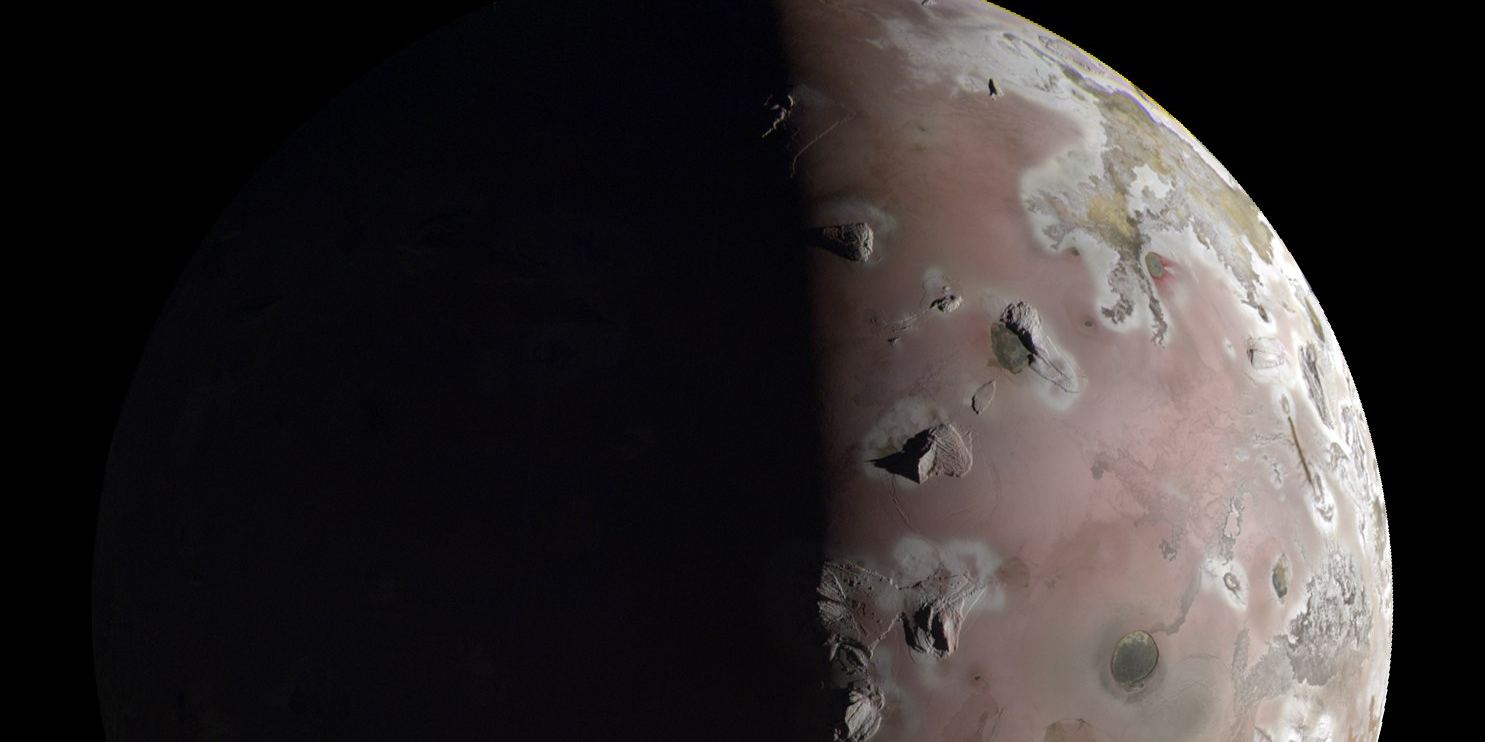
Io seen by Juno (processed by Jason Perry): NASA / SWRI / MSSS / Jason Perry, Public domain
The most volcanic place we know
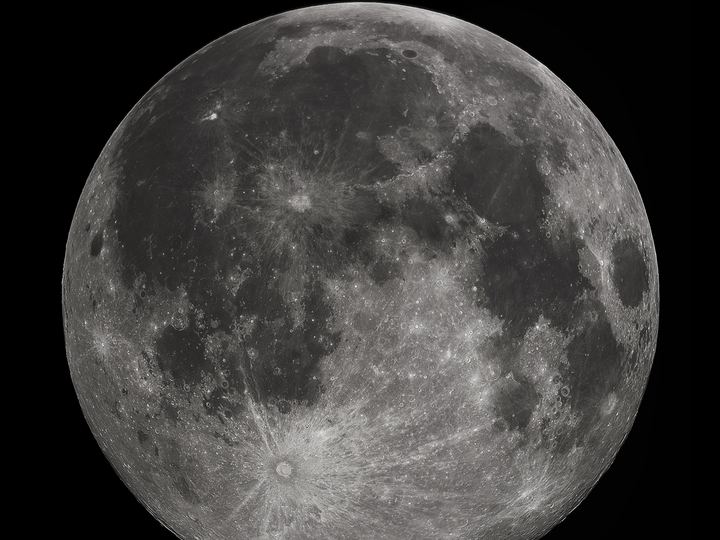
Io is slightly larger than Earth's Moon, but it could hardly be more different. Instead of old craters, its surface is covered with lava flows, volcanic pits and plumes of sulfur that shoot hundreds of kilometres into space. Scientists count about 400 active volcanoes, and the surface is constantly repaved, so no impact craters survive for long.
The yellows, oranges, reds and whites come from sulfur and frozen sulfur dioxide, while dark spots are hot silicate lava.
Squeezed by gravity
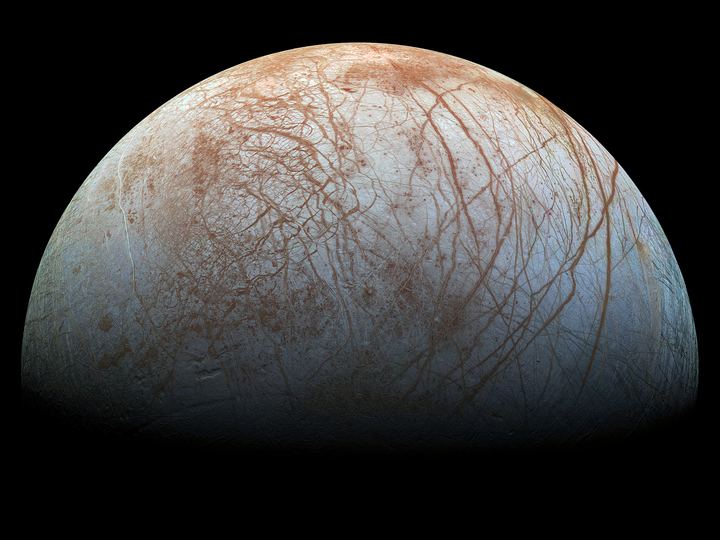
Io's heat does not come from radioactivity like Earth's. It comes from tides. Io is locked in an orbital rhythm with Europa and Ganymede: for every orbit Ganymede completes, Europa completes two and Io four. These regular tugs keep Io's orbit slightly oval, so Jupiter's enormous gravity flexes the moon's interior again and again, heating it by friction.
The effect is so strong that Io's solid surface can rise and fall by around 100 metres as it orbits.
Exploring Io
Voyager 1 discovered active volcanism on Io in 1979, the first time it had been seen beyond Earth. The Galileo orbiter studied the moon through the late 1990s and early 2000s, and NASA's Juno spacecraft made two very close flybys in December 2023 and February 2024, passing within about 1,500 km and photographing lava lakes and mountains near the poles.
Io also feeds a doughnut-shaped ring of charged particles around Jupiter, called the Io plasma torus, which shapes the giant planet's magnetic environment.
Why it matters
Io is a natural laboratory for tidal heating, the same process that may keep oceans liquid inside Europa and Enceladus. Studying how heat escapes from Io helps scientists understand young rocky planets and even exoplanets that orbit close to their stars. Its extreme activity also reminds us that a small world can stay geologically alive for billions of years if it has the right neighbours.
- Io seen by Juno (processed by Jason Perry): NASA / SWRI / MSSS / Jason Perry, Public domain
Text written by Planetinio.