Callisto
The battered, ancient moon. Callisto is the most heavily cratered object in the solar system, an ancient surface barely changed in billions of years. Facts and future missions.
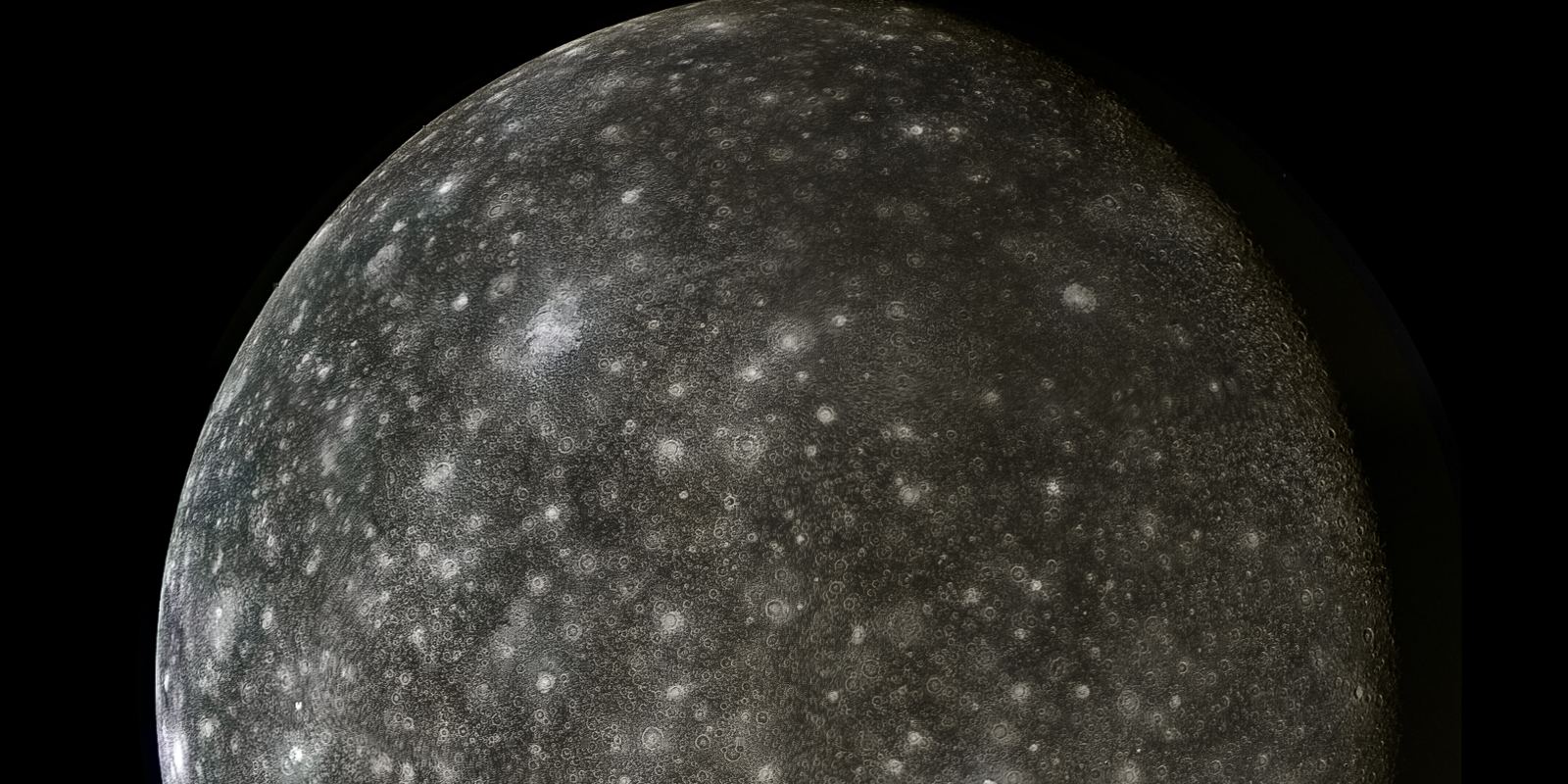
Callisto from Voyager 2: Kevin Gill from Los Angeles, CA, United States, CC BY 2.0
A record of ancient impacts
Callisto is the third largest moon in the solar system and the outermost of Jupiter's four large Galilean moons. Its dark surface is packed with craters, more densely than any other known world, which means it has been geologically quiet for most of the solar system's history.
Its largest feature, the Valhalla basin, is a bright central region surrounded by rings of ridges stretching hundreds of kilometres, like ripples frozen in ice.
Not in the rhythm
Unlike Io, Europa and Ganymede, Callisto is not part of the orbital resonance that drives tidal heating, so it has stayed cold and inactive. Its interior seems only partly separated into layers of rock and ice. Even so, magnetic measurements by Galileo hinted at a salty ocean far beneath the surface.
A future base?
Because Callisto orbits outside Jupiter's most intense radiation belts, it has been suggested in NASA studies as a possible location for a future human outpost in the Jupiter system. That remains a long-term idea, but it shows how practical concerns like radiation shape exploration plans.
Exploring Callisto
Voyager 1 and 2 photographed Callisto in 1979, and the Galileo orbiter flew past it many times in the 1990s and 2000s. ESA's JUICE spacecraft will make several close flybys of Callisto in the 2030s, studying its surface and searching for signs of the suspected ocean. Its ancient craters will help scientists count how often impacts happened in the outer solar system.
Seeing it yourself
Callisto is the outermost of the four moons you can spot beside Jupiter with binoculars, and it can appear farther from the planet than the others. Because it takes almost 17 days to orbit, it moves more slowly from night to night. Watching Callisto drift away from Jupiter and back again over two weeks is a simple, satisfying way to see orbital motion with your own eyes, and a nice project to share with children.
- Callisto from Voyager 2: Kevin Gill from Los Angeles, CA, United States, CC BY 2.0
Text written by Planetinio.