Titan
A moon with rain, rivers and seas. Saturn's moon Titan has a thick atmosphere and lakes of liquid methane. What Cassini and the Huygens probe found, and NASA's Dragonfly mission.
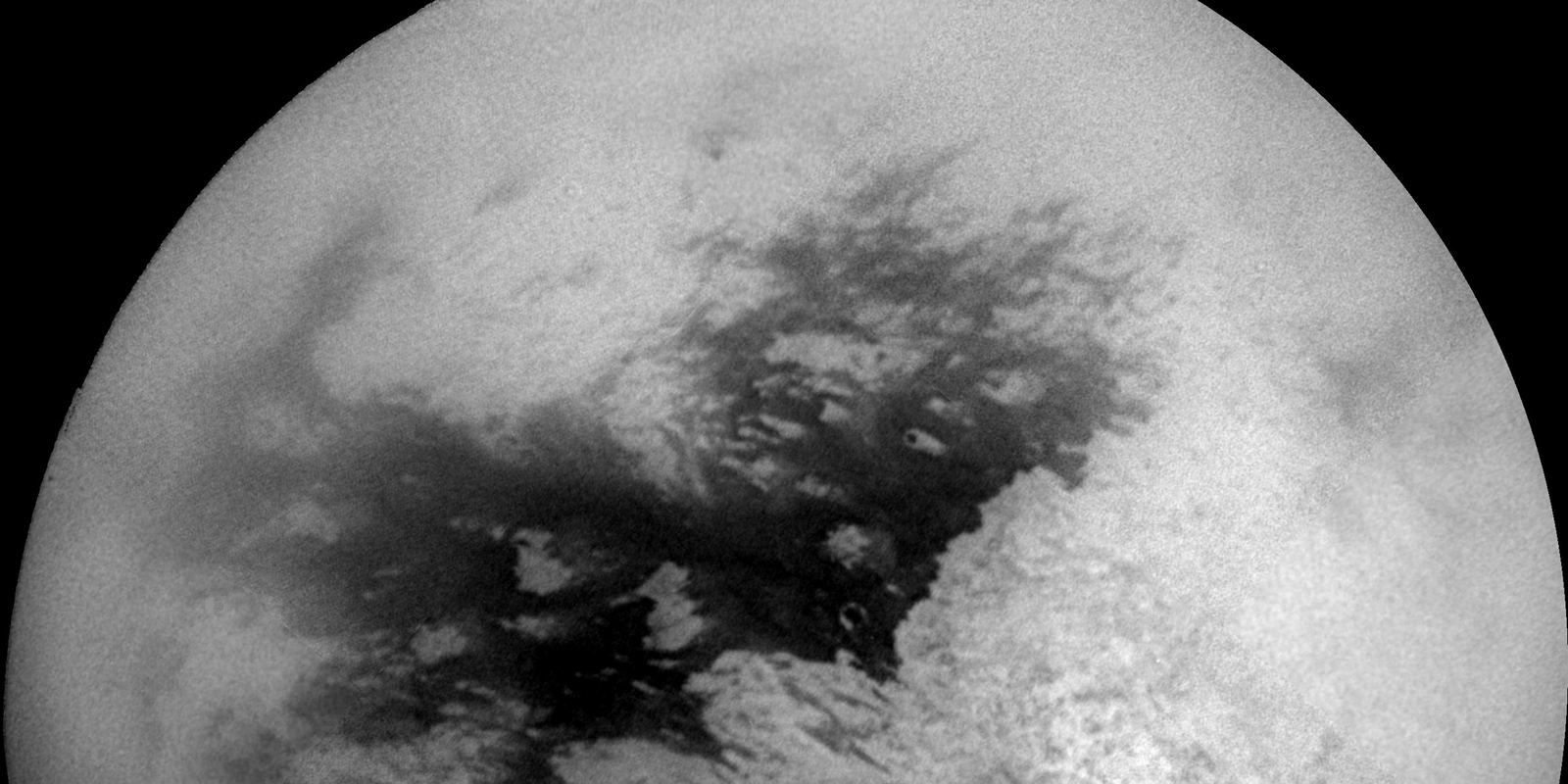
Titan's hazy atmosphere (Cassini): NASA/JPL/Space Science Institute, Public domain
An orange world
Titan is Saturn's largest moon and the second largest in the solar system. It is the only moon with a thick atmosphere, made mostly of nitrogen with some methane. Sunlight breaks down methane high up, producing an orange smog that hides the surface from ordinary cameras.
Standing on Titan, you would feel air pressure about one and a half times Earth's, but the temperature is about minus 179 degrees Celsius.
A weather cycle like Earth's, with different liquids
On Titan, methane plays the role water plays on Earth. It forms clouds, falls as rain, carves river channels and collects in lakes and seas near the poles. The largest, Kraken Mare, is bigger than the Caspian Sea area-wise on a much smaller world. Below the crust, scientists think Titan also has an ocean of liquid water.
Cassini's radar mapped dunes of organic grains across the equator, like the sand seas of Earth's deserts.
Huygens and Cassini
The European Huygens probe rode to Saturn on NASA's Cassini spacecraft and parachuted onto Titan on January 14, 2005. It sent back images of rounded pebbles on a damp, sandy plain, the most distant landing ever made. Cassini flew past Titan more than 100 times between 2004 and 2017.
Dragonfly
NASA's Dragonfly is a car-sized, nuclear-powered rotorcraft designed to fly from place to place on Titan, sampling organic chemistry. It is planned to launch in 2028 and arrive in the mid 2030s. Titan's thick air and low gravity make flying there easier than on Earth. Scientists hope Dragonfly will reveal how far prebiotic chemistry can go on a world without liquid water at the surface.
Seeing it yourself
Titan is bright enough to see in a small backyard telescope as a faint orange-yellow dot near Saturn, usually several ring-widths away from the planet. It was the first moon of Saturn ever discovered, by Christiaan Huygens in 1655, using a telescope he built himself. On a clear night with Saturn high in the sky, finding Titan is a great first target after admiring the rings.
- Titan's hazy atmosphere (Cassini): NASA/JPL/Space Science Institute, Public domain
Text written by Planetinio.