Enceladus

Geysers from a hidden ocean. Saturn's small moon Enceladus sprays water from an underground ocean into space. The tiger stripes, Cassini's discoveries and the search for life.
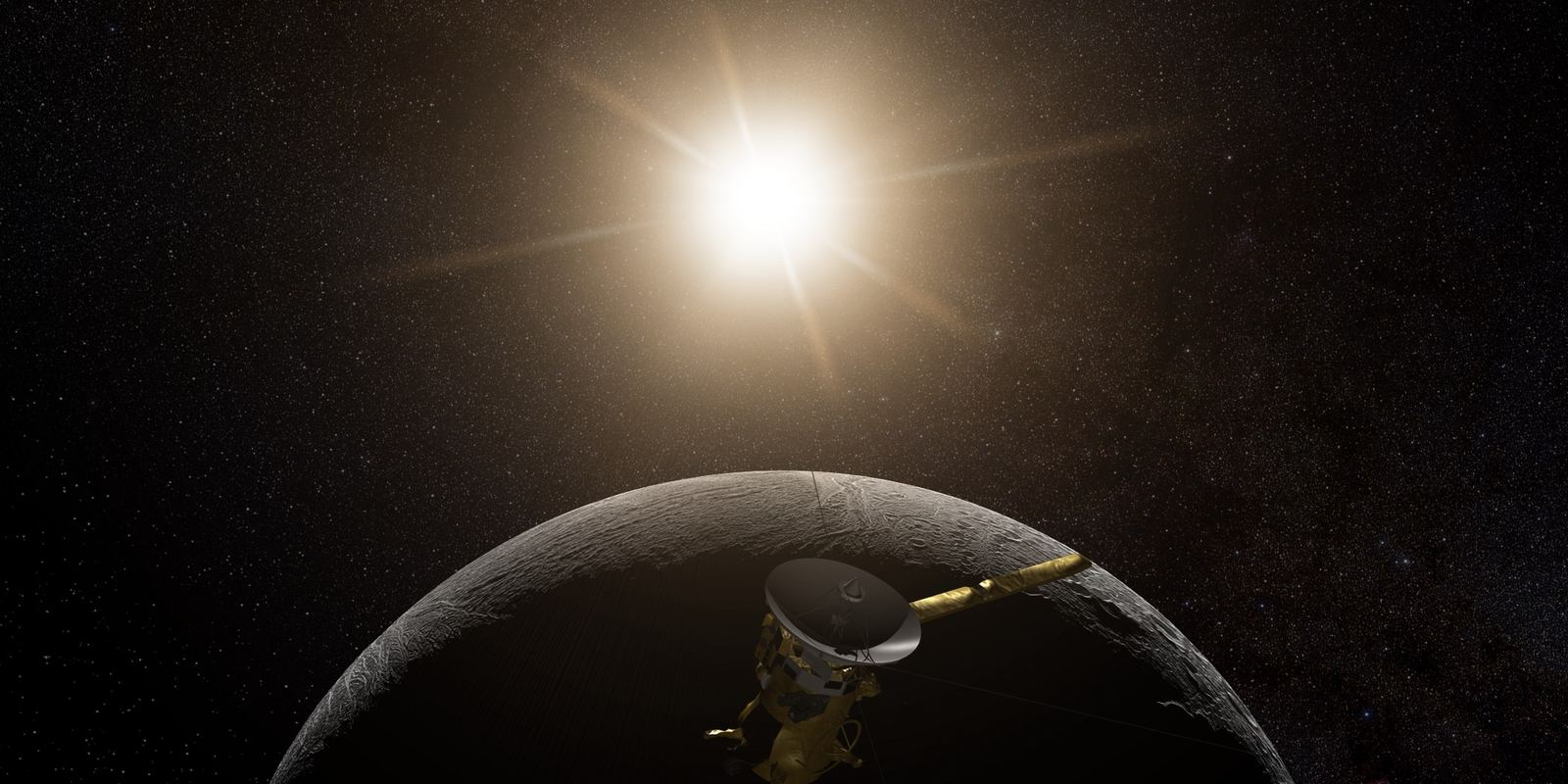
The icy moon Enceladus with Saturn in the background

Enceladus (Cassini data, processed by Kevin M. Gill): Kevin M. Gill, CC BY 2.0

A small, shining moon

Enceladus is only about 500 km across, small enough to fit inside the UK, yet it is one of the most exciting places in the solar system. Its surface of fresh ice reflects almost all the sunlight that hits it, making it one of the brightest objects we know.

The tiger stripes

In 2005, NASA's Cassini spacecraft discovered jets of water vapour and ice grains erupting from four long fractures near the south pole, nicknamed tiger stripes. These plumes shoot material far into space, and much of it ends up in Saturn's faint E ring.

The jets are powered by tidal heating as Saturn's gravity flexes the moon, and they point to a global ocean beneath the ice.

Tasting the ocean

Cassini flew directly through the plumes several times, sampling them with its instruments. It detected salts, silica particles that suggest hot water reacting with rock, and molecular hydrogen, a possible energy source for microbes. Later analysis of Cassini data also found phosphates, an important ingredient for life as we know it.

Together, these findings make Enceladus one of the top places to search for life beyond Earth.

What comes next

Scientists have proposed missions that would orbit Enceladus or land near the tiger stripes to analyse fresh plume material. ESA has studied a large mission to Enceladus for the 2040s. Until then, Cassini's data, gathered before the spacecraft ended its mission in 2017, remains the best evidence we have.

Why scientists are so excited

Very few places in the solar system offer free samples of a hidden ocean. On Europa, any plumes are faint and uncertain, but on Enceladus the spray is constant and strong, so a spacecraft can simply fly through it and analyse what comes out. That is why many researchers rank Enceladus as one of the best places to look for life, and why mission planners keep coming back to it.

Media credits
  • Enceladus (Cassini data, processed by Kevin M. Gill): Kevin M. Gill, CC BY 2.0

Text written by Planetinio.
← TitanTriton →

Shop

The Planetinio collection

Tees and hoodies in the Planetinio colors, printed to order in the USA. Use code VIP15 from the newsletter for 15% off your first order.

Watch

Planetinio Shorts

Quick, accurate, under a minute. Every Short is original and made only for this channel.

YouTube @PlanetinioSpace
New Shorts every day. Subscribe so you never miss one.
Subscribe

Latest Shorts

Neptune has the fastest winds in the solar systemPhotos: Neptune Full.jpg - NASA (Public domain) via Wikimedia Commons | Neptune - Voyager 2 (29347980845) flatten crop.jpg - NASA / JPL / Voyager-ISS / Aster Cowart (Public domain) via Wikimedia Commons | Great Dark Spot (cropped).jpg - NASA (Public domain) via Wikimedia Commons | PIA00048 Great Dark Spot and Scooter (cropped).jpg - NASA/JPL (Public domain) via Wikimedia Commons | PIA00063 Neptune - True
Sunsets on Mars are bluePhotos: Carbon dioxide clouds over Mont Mercou, Curiosity Sol 3063 (53100058892).jpg - semeion.photo Credit: NASA/JPL-Caltech/MSSS/Simeon Schmauß (CC BY 2.0) via Wikimedia Commons | Martian-Sunset-O-de-Goursac-Curiosity-2013.jpg - NASA/JPL/MSSS; processings and mosaic: Olivier de Goursac (f (CC BY-SA 3.0) via Wikimedia Commons | Iridescent clouds over Gale Crater (enhanced color) (54302292059).jpg - semei
The Moon is slowly running away from EarthPhotos: Apollo 11 Lunar Laser Ranging Experiment.jpg - NASA (Public domain) via Wikimedia Commons | Laser Ranging Retro-Reflector, Apollo (NASM2020-00367).jpg - Smithsonian National Air and Space Museum/Mark Avino (CC0) via Wikimedia Commons | Lunar Laser Ranging at the Observatoire de la Côte d'Azur DSC 0729 (10782460465).jpg - Melirius (CC BY-SA 2.0) via Wikimedia Commons | ALSEP AS14-67-9386 (cropped).
The planet closest to the Sun has ice on itPhotos: MESSENGER first photo of unseen side of mercury.jpg - NASA/Johns Hopkins University Applied Physics Laboratory/Car (Public domain) via Wikimedia Commons | Mercury in color - Prockter07 centered.jpg - NASA/Johns Hopkins University Applied Physics Laboratory/Car (Public domain) via Wikimedia Commons | Mercury in color - Prockter07-edit1.jpg - National Aeronautics and Space Administration/Johns Hopki
Uranus spins on its side like a rolling ballPhotos: Uranus from Voyager 2.jpg - NASA (Public domain) via Wikimedia Commons | Uranus2.jpg - NASA/JPL-Caltech (Public domain) via Wikimedia Commons | Uranus rings and moons.jpg - Erich Karkoschka (University of Arizona) and NASA/ESA (Public domain) via Wikimedia Commons | Hubble Observes the Planet Uranus (opo9450b).jpg - Kenneth Seidelmann, U.S. Naval Observatory,and NASA/ESA (Public domain) via Wikime
Newsletter

Tonight's sky, monthly

One short email at the start of each month: the Moon phases, the meteor showers worth staying up for and which planets are on show, plus new pages and Shorts.