Phobos and Deimos
The two little moons of Mars. Mars has two small, potato-shaped moons, Phobos and Deimos. Their discovery, odd orbits, possible origin and Phobos' slow fall toward Mars.
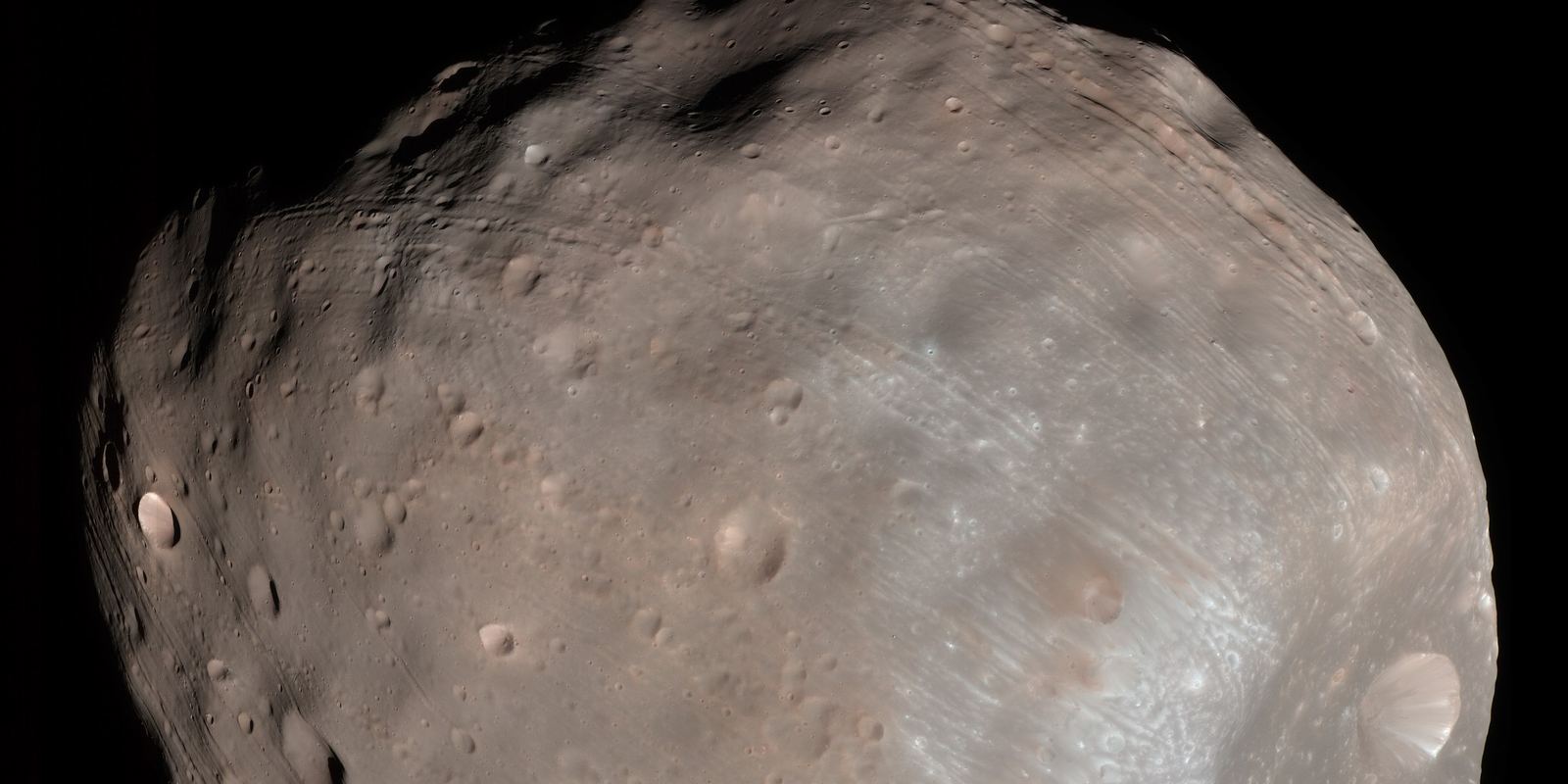
Phobos (Mars Reconnaissance Orbiter): NASA / JPL-Caltech / University of Arizona, Public domain
Two tiny moons
Mars has two moons, Phobos and Deimos, discovered by American astronomer Asaph Hall in August 1877 at the US Naval Observatory. Both are small and irregular, more like asteroids than our round Moon. Phobos, the larger, is about 27 km across at its longest; Deimos is about 15 km.
Strange orbits
Phobos orbits just 6,000 km above the Martian surface, closer than any other known moon to its planet. It goes around Mars three times a day, so from the surface it rises in the west and sets in the east. Deimos orbits farther out and takes about 30 hours.
Tides are slowly pulling Phobos inward, by about 2 metres per century. In roughly 30 to 50 million years it will either crash into Mars or break up into a ring.
Where did they come from?
Scientists still debate their origin. Their dark, asteroid-like surfaces suggest captured asteroids, but their nearly circular orbits around Mars' equator fit better with formation from debris after a giant impact on Mars. Close study of their rocks could settle the question.
Missions to Phobos
Phobos' largest crater, Stickney, is about 9 km wide, almost a third of the moon's length. Japan's MMX (Martian Moons eXploration) mission is planned to land on Phobos, collect a sample and bring it back to Earth, which would be the first sample ever returned from the Mars system. Mars orbiters such as Mars Reconnaissance Orbiter and Mars Express have photographed both moons in detail.
What you would see from Mars
From the Martian surface, Phobos would look about a third as wide as our full Moon looks from Earth, racing across the sky twice a day. Deimos would look like a bright star. Perseverance and Curiosity have both filmed Phobos passing in front of the Sun, creating fast, partial eclipses that last less than a minute. Those videos help scientists measure Phobos' orbit very precisely.
- Phobos (Mars Reconnaissance Orbiter): NASA / JPL-Caltech / University of Arizona, Public domain
Text written by Planetinio.