Ceres
The dwarf planet in the asteroid belt. Ceres is the largest object in the asteroid belt and the closest dwarf planet to the Sun. Its bright spots, briny interior and the Dawn mission.
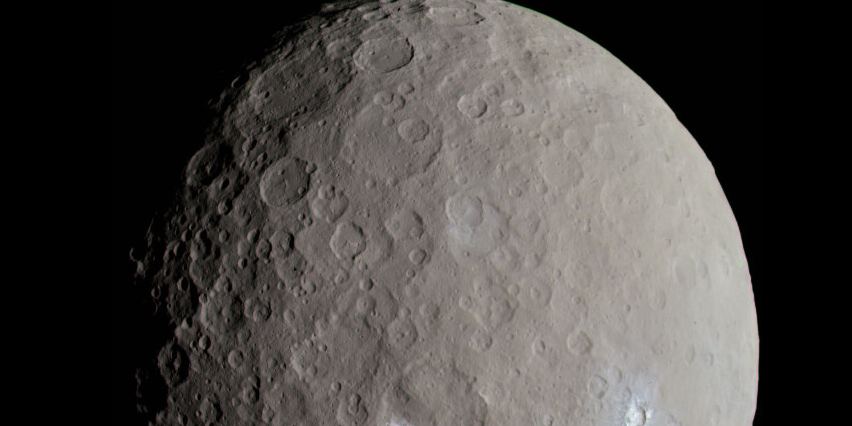
Ceres (Dawn data, processed by Justin Cowart): Justin Cowart, Public domain
First found, then reclassified
Giuseppe Piazzi discovered Ceres from Sicily on January 1, 1801, and for a while it was counted as a planet. As more objects were found in the same region, it became known as the largest asteroid. In 2006, the International Astronomical Union created the dwarf planet category, and Ceres joined Pluto and Eris in it.
Ceres makes up roughly a third of the total mass of the asteroid belt.
Dawn's discoveries
NASA's Dawn spacecraft, which used ion engines, orbited the asteroid Vesta and then Ceres, arriving in 2015. It was the first spacecraft to orbit two different worlds beyond Earth. Dawn found that Ceres is rich in water ice and clays, and that its famous bright spots in Occator Crater are deposits of salts, mainly sodium carbonate, left behind when briny water reached the surface and evaporated.
A hidden brine
Data suggest there is still a reservoir of salty liquid deep beneath Occator Crater. That makes Ceres an ocean world of sorts, close to the Sun compared with the icy moons of Jupiter and Saturn. A tall, lonely mountain called Ahuna Mons is probably an ice volcano, a cryovolcano, made of salty ice.
Seeing Ceres
Ceres is too faint to see without help, but with binoculars or a small telescope it appears as a star-like dot that moves slowly against the background stars from night to night. Astronomy apps can show where it is. Dawn ran out of fuel in 2018 and remains in a stable orbit around the dwarf planet.
Why Ceres matters
Ceres sits at an interesting crossroads between rocky and icy worlds. Its mix of rock, ice and salts suggests that material from the outer solar system may have drifted inward early on. Some scientists have suggested Ceres could be a useful stepping stone for future exploration because of its water ice and low gravity. For now, Dawn's maps remain the main guide to this quiet but surprising dwarf planet.
- Ceres (Dawn data, processed by Justin Cowart): Justin Cowart, Public domain
Text written by Planetinio.