Eris
The dwarf planet that changed the planet count. Eris, a distant dwarf planet about the size of Pluto, triggered the 2006 debate that defined what a planet is. Discovery, orbit and its moon Dysnomia.
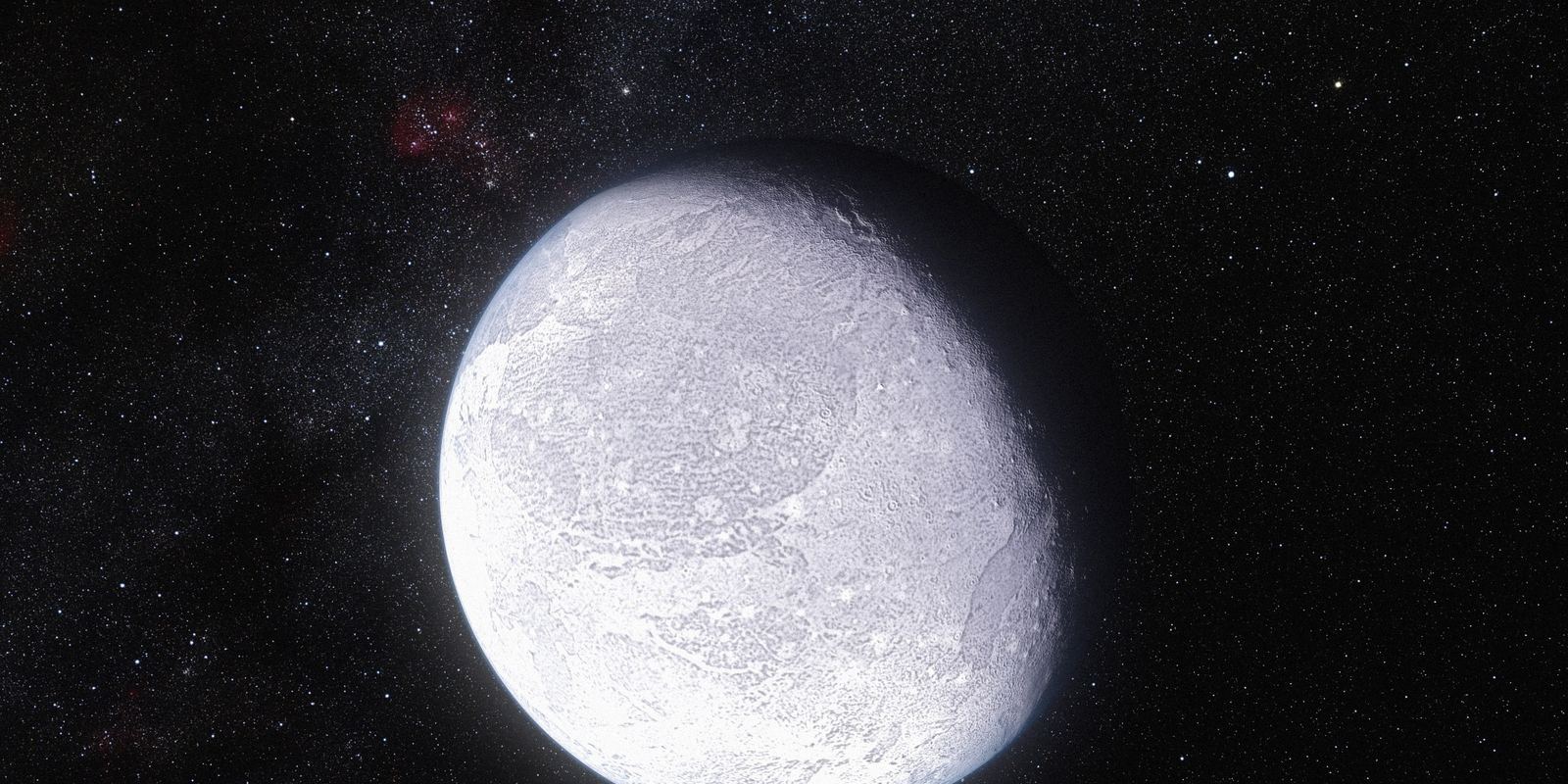
Eris (artist's impression, ESO): ESO/L. Calçada and Nick Risinger (skysurvey.org), CC BY 4.0
The discovery that started a debate
In 2005, astronomers Mike Brown, Chad Trujillo and David Rabinowitz announced a distant world, found in images taken in 2003 at Palomar Observatory, that seemed bigger than Pluto. If Pluto was a planet, was this the tenth? The question forced astronomers to define the word planet.
A new definition
In August 2006 the International Astronomical Union agreed that a planet must orbit the Sun, be massive enough to be round, and have cleared its orbital neighbourhood of other objects. Pluto and Eris fail the last test, so they became dwarf planets. The new object was named Eris, a word linked to strife in ancient Greek stories, a fitting name for a world that caused so much argument.
Later measurements showed Eris is very slightly smaller than Pluto in diameter, but about a quarter more massive.
A long, tilted orbit
Eris follows a stretched, steeply tilted orbit that takes about 557 years. It is currently near its farthest point, almost three times as far from the Sun as Pluto. At that distance its surface is extremely cold, and its atmosphere is frozen onto the ground as a bright frost.
Eris also shows how discoveries keep reshaping science. A single new object forced astronomers to rethink a word everyone thought they understood, and the debate over Pluto's status still sparks friendly arguments among scientists and fans today.
Dysnomia and the scattered disc
Eris has one known moon, Dysnomia, and studying its orbit is how astronomers weighed Eris. Eris belongs to the scattered disc, a population of icy bodies beyond Neptune with eccentric orbits, related to the Kuiper Belt. No spacecraft has visited it, and none is planned, so for now everything we know comes from telescopes.
Other dwarf planets
The IAU currently recognises five dwarf planets: Ceres, Pluto, Haumea, Makemake and Eris. Many astronomers think dozens more, such as Gonggong, Quaoar and Sedna, may qualify once their sizes and shapes are better known. Each of these faraway worlds is a clue to how the solar system's outer region formed, and new telescopes keep finding more of them every year.
- Eris (artist's impression, ESO): ESO/L. Calçada and Nick Risinger (skysurvey.org), CC BY 4.0
Text written by Planetinio.