Asteroids and Bennu

Rocks from the dawn of the solar system. Asteroids are leftovers from the solar system's birth. The asteroid belt, near-Earth asteroids and what OSIRIS-REx brought home from Bennu in 2023.
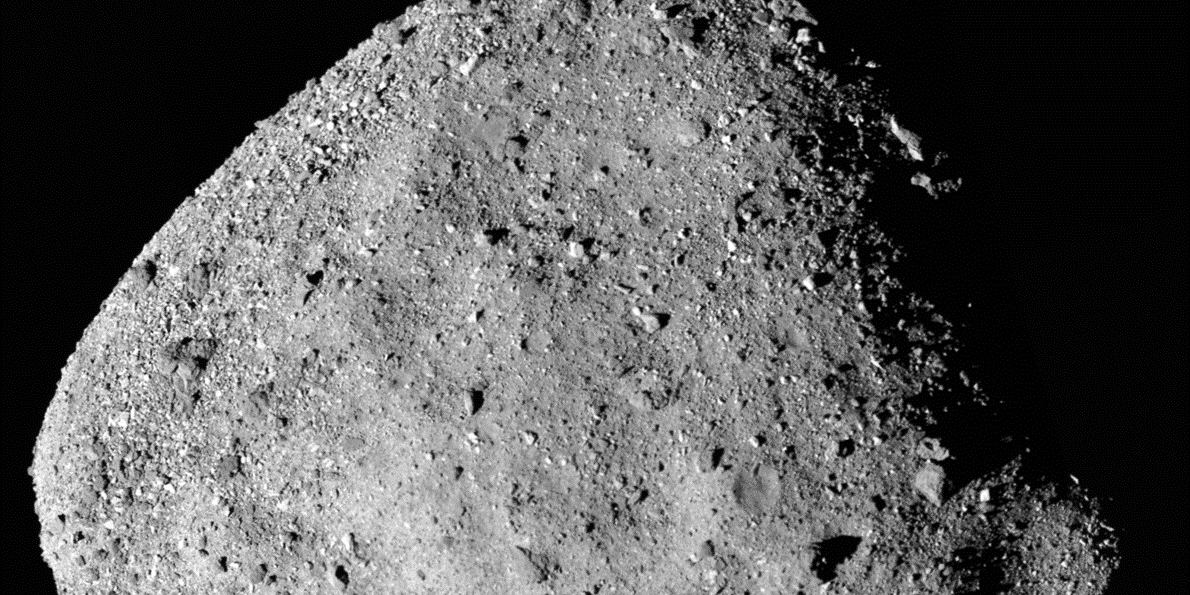
The diamond-shaped, boulder-covered asteroid Bennu

Asteroid Bennu (OSIRIS-REx): NASA/Goddard/University of Arizona, Public domain

Leftover building blocks

Asteroids are rocky or metallic bodies left over from the formation of the planets about 4.6 billion years ago. Most orbit in the main asteroid belt between Mars and Jupiter, where Jupiter's gravity kept them from forming a planet. Despite movie images, the belt is mostly empty space: spacecraft fly through it without dodging.

Together, all the main belt asteroids have less mass than our Moon.

Near-Earth asteroids

Some asteroids have orbits that bring them close to Earth. NASA and other agencies track them to spot any that could pose a risk. In 2022, NASA's DART mission deliberately crashed into the small asteroid Dimorphos and changed its orbit, the first test of a technique that could one day nudge a dangerous asteroid away.

Visiting Bennu

NASA's OSIRIS-REx launched in 2016 to Bennu, a small, carbon-rich near-Earth asteroid. When it touched down to grab a sample in October 2020, the surface behaved almost like a ball pit, and the sampler sank in. The capsule landed in the Utah desert on September 24, 2023, carrying about 121.6 grams of rock and dust, the largest asteroid sample ever returned.

Scientists have found water-bearing minerals and organic molecules, including amino acids, in the sample.

What comes next

The spacecraft, renamed OSIRIS-APEX, is heading to the asteroid Apophis, which will pass safely but very close to Earth in April 2029. Japan's Hayabusa2 also returned samples from the asteroid Ryugu in 2020. Studying these pristine materials helps answer where Earth's water and the ingredients for life came from.

Can you see an asteroid?

A few large asteroids, such as Vesta, can be glimpsed with binoculars when they are well placed, looking like faint stars that move from night to night. Astronomy apps show their positions. Most meteorites that land on Earth are fragments of asteroids, and some museums let you touch one, which is the closest most of us will get to holding a piece of the early solar system.

Media credits
  • Asteroid Bennu (OSIRIS-REx): NASA/Goddard/University of Arizona, Public domain

Text written by Planetinio.
← ErisComets →

Shop

The Planetinio collection

Tees and hoodies in the Planetinio colors, printed to order in the USA. Use code VIP15 from the newsletter for 15% off your first order.

Watch

Planetinio Shorts

Quick, accurate, under a minute. Every Short is original and made only for this channel.

YouTube @PlanetinioSpace
New Shorts every day. Subscribe so you never miss one.
Subscribe

Latest Shorts

Neptune has the fastest winds in the solar systemPhotos: Neptune Full.jpg - NASA (Public domain) via Wikimedia Commons | Neptune - Voyager 2 (29347980845) flatten crop.jpg - NASA / JPL / Voyager-ISS / Aster Cowart (Public domain) via Wikimedia Commons | Great Dark Spot (cropped).jpg - NASA (Public domain) via Wikimedia Commons | PIA00048 Great Dark Spot and Scooter (cropped).jpg - NASA/JPL (Public domain) via Wikimedia Commons | PIA00063 Neptune - True
Sunsets on Mars are bluePhotos: Carbon dioxide clouds over Mont Mercou, Curiosity Sol 3063 (53100058892).jpg - semeion.photo Credit: NASA/JPL-Caltech/MSSS/Simeon Schmauß (CC BY 2.0) via Wikimedia Commons | Martian-Sunset-O-de-Goursac-Curiosity-2013.jpg - NASA/JPL/MSSS; processings and mosaic: Olivier de Goursac (f (CC BY-SA 3.0) via Wikimedia Commons | Iridescent clouds over Gale Crater (enhanced color) (54302292059).jpg - semei
The Moon is slowly running away from EarthPhotos: Apollo 11 Lunar Laser Ranging Experiment.jpg - NASA (Public domain) via Wikimedia Commons | Laser Ranging Retro-Reflector, Apollo (NASM2020-00367).jpg - Smithsonian National Air and Space Museum/Mark Avino (CC0) via Wikimedia Commons | Lunar Laser Ranging at the Observatoire de la Côte d'Azur DSC 0729 (10782460465).jpg - Melirius (CC BY-SA 2.0) via Wikimedia Commons | ALSEP AS14-67-9386 (cropped).
The planet closest to the Sun has ice on itPhotos: MESSENGER first photo of unseen side of mercury.jpg - NASA/Johns Hopkins University Applied Physics Laboratory/Car (Public domain) via Wikimedia Commons | Mercury in color - Prockter07 centered.jpg - NASA/Johns Hopkins University Applied Physics Laboratory/Car (Public domain) via Wikimedia Commons | Mercury in color - Prockter07-edit1.jpg - National Aeronautics and Space Administration/Johns Hopki
Uranus spins on its side like a rolling ballPhotos: Uranus from Voyager 2.jpg - NASA (Public domain) via Wikimedia Commons | Uranus2.jpg - NASA/JPL-Caltech (Public domain) via Wikimedia Commons | Uranus rings and moons.jpg - Erich Karkoschka (University of Arizona) and NASA/ESA (Public domain) via Wikimedia Commons | Hubble Observes the Planet Uranus (opo9450b).jpg - Kenneth Seidelmann, U.S. Naval Observatory,and NASA/ESA (Public domain) via Wikime
Newsletter

Tonight's sky, monthly

One short email at the start of each month: the Moon phases, the meteor showers worth staying up for and which planets are on show, plus new pages and Shorts.