Comets
Dirty snowballs with glowing tails. Comets are icy visitors from the edge of the solar system. How their tails form, famous comets like Halley and Hale-Bopp, and the Rosetta mission.
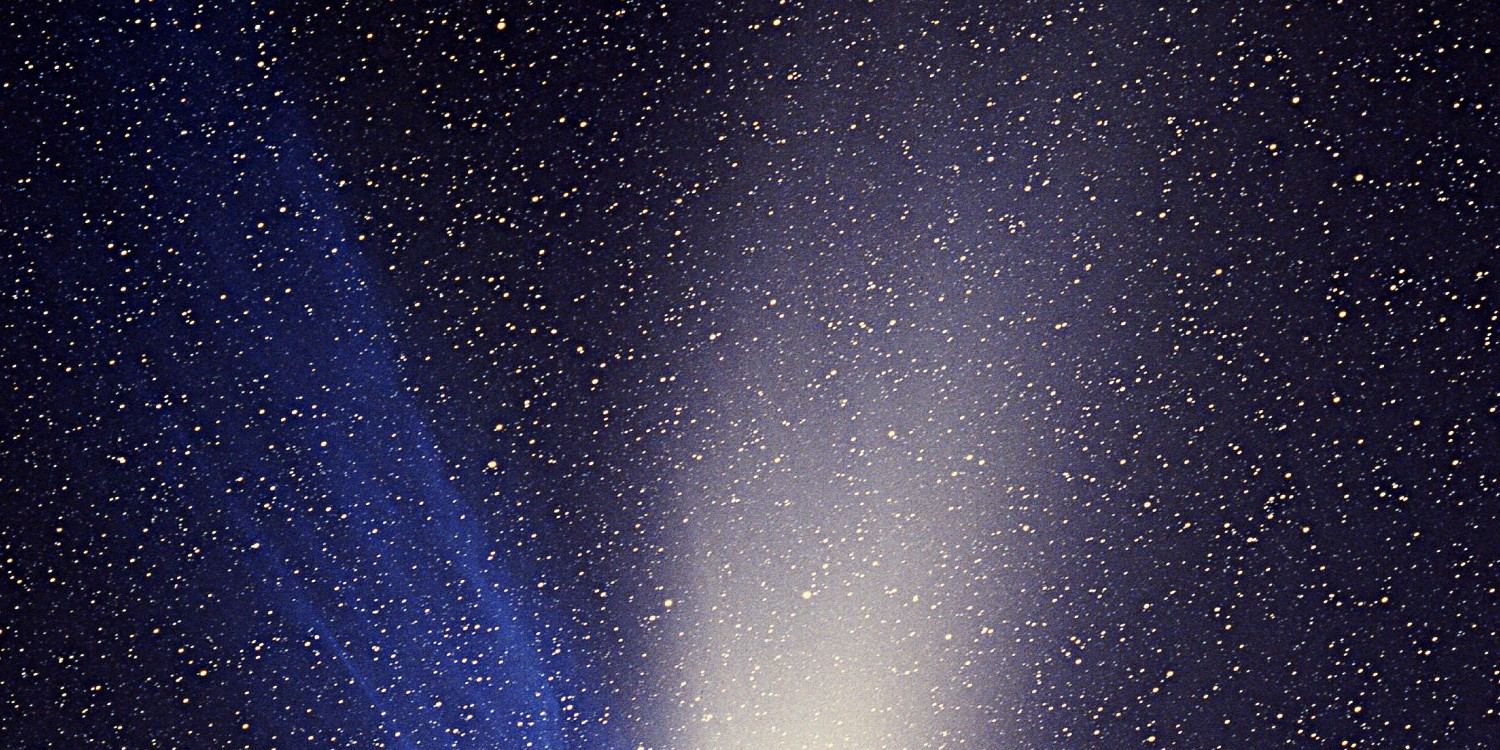
Comet Hale-Bopp, 1997: E. Kolmhofer, H. Raab; Johannes-Kepler-Observatory, Linz, Austria (https://stern, CC BY-SA 3.0
What a comet is
A comet is a lump of ice, dust and rock, often only a few kilometres across, called the nucleus. Far from the Sun it is frozen and dark. As it approaches the Sun, the ices turn to gas and release dust, forming a glowing cloud called the coma.
Comets come from two distant reservoirs: the Kuiper Belt beyond Neptune, home to many short-period comets, and the much more distant Oort Cloud, the source of long-period comets.
Two tails
Many comets grow two tails. The dust tail is curved and yellowish, made of grains pushed gently by sunlight. The ion tail is straight and often blue, made of electrically charged gas blown directly away from the Sun by the solar wind. Tails always point away from the Sun, so a comet travelling outward goes tail first.
Famous comets
Halley's Comet returns about every 76 years and has been recorded for more than two thousand years; its last visit was in 1986 and it will be back in 2061. Comet Hale-Bopp, discovered in 1995, was visible to the naked eye for about 18 months, longer than any other recorded comet. In 2020, Comet NEOWISE gave skywatchers a beautiful show in the northern hemisphere.
Landing on a comet
ESA's Rosetta spacecraft orbited comet 67P/Churyumov-Gerasimenko from 2014 to 2016, and its lander Philae made the first landing on a comet in November 2014. Rosetta watched the comet become active as it neared the Sun. Meteor showers such as the Perseids happen when Earth passes through dust left behind by comets.
How to see a comet
Most comets are faint and need binoculars or a telescope, but every few years one becomes bright enough to see easily. Astronomy news sites and apps announce them in advance. Find a dark place away from city lights, let your eyes adjust for 20 minutes, and look in the direction given in the forecast, usually low in the sky just after sunset or before dawn.
- Comet Hale-Bopp, 1997: E. Kolmhofer, H. Raab; Johannes-Kepler-Observatory, Linz, Austria (https://stern, CC BY-SA 3.0
Text written by Planetinio.