Voyager 1 and 2
The farthest travellers. Launched in 1977, Voyager 1 and 2 toured the giant planets and became the first spacecraft in interstellar space. Their journey and Golden Records.
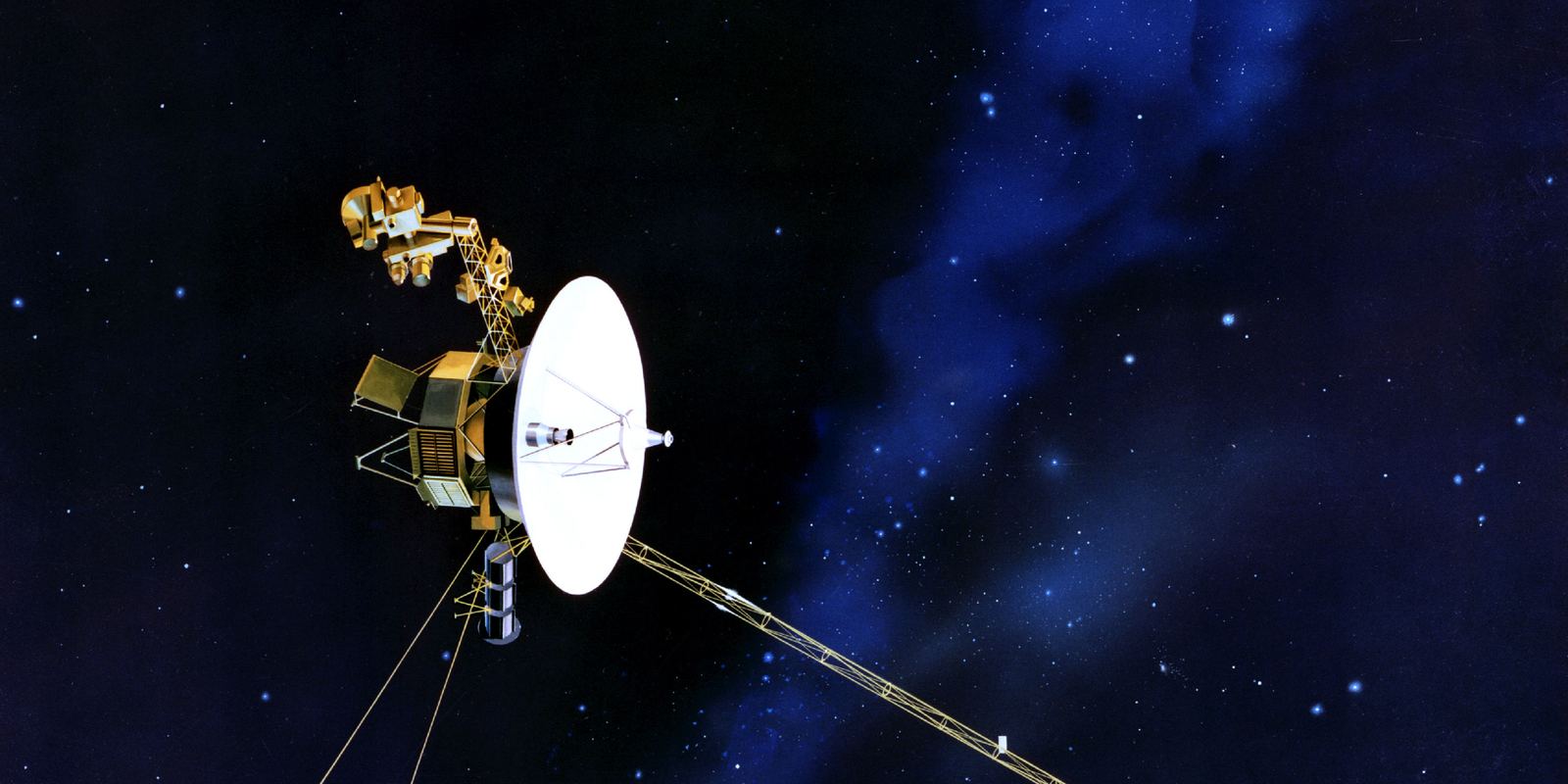
A Voyager spacecraft: NASA/JPL, Public domain
A rare planetary alignment
In the late 1970s the outer planets lined up in a way that happens about once every 175 years, allowing a spacecraft to swing from one giant planet to the next using gravity assists. NASA launched two identical spacecraft in 1977 to take advantage of it.
The grand tour
Voyager 1 flew past Jupiter in 1979 and Saturn in 1980, then headed out of the solar system. Voyager 2 visited Jupiter, Saturn, Uranus in 1986 and Neptune in 1989. It is still the only spacecraft to have visited Uranus and Neptune.
The Voyagers discovered active volcanoes on Io, studied Saturn's rings in detail and found geysers on Neptune's moon Triton.
Into interstellar space
In August 2012, Voyager 1 crossed the heliopause, the boundary where the Sun's solar wind gives way to the gas between the stars. Voyager 2 followed in November 2018. Voyager 1 is the most distant human-made object, more than 24 billion kilometres from Earth, and its radio signals take about a day to reach us.
Engineers have switched off instruments and heaters one by one to save power, and expect the spacecraft to fall silent within the next few years.
The Golden Record
Each Voyager carries a gold-plated copper record with greetings in 55 languages, music from many cultures, natural sounds and encoded images of life on Earth. A committee led by Carl Sagan chose its contents. The record is a message in a bottle: even after the spacecraft go silent, they will drift among the stars for millions of years.
The Pale Blue Dot
On February 14, 1990, at Carl Sagan's suggestion, Voyager 1 turned its camera back toward home and photographed Earth from about 6 billion km away. In the image, our planet is a tiny speck less than a pixel wide, caught in a sunbeam. The photo, known as the Pale Blue Dot, became one of the most famous images in science and a powerful reminder of how small and precious our world is.
- A Voyager spacecraft: NASA/JPL, Public domain
Text written by Planetinio.