Juno

Solar-powered explorer at Jupiter. NASA's Juno has orbited Jupiter since 2016, studying its storms, magnetic field and moons. How it works and what it has discovered so far.
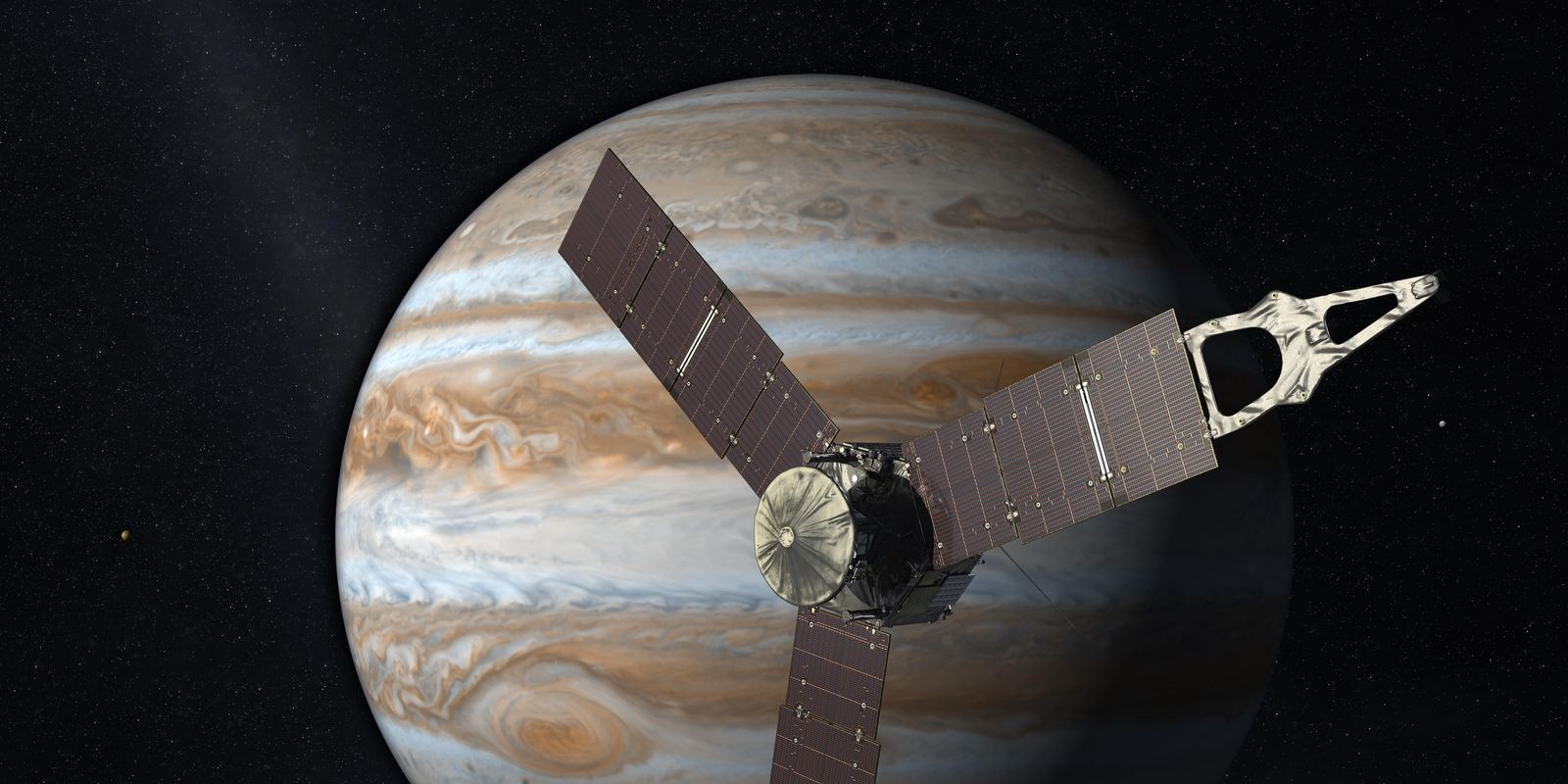
Artist's concept of the Juno spacecraft with three long solar arrays above Jupiter

Juno at Jupiter (artist's concept): NASA/JPL, Public domain

Built for Jupiter

Juno launched in 2011 and reached Jupiter on July 4, 2016. It was the first solar-powered spacecraft sent so far from the Sun, using three huge solar arrays. Its electronics sit inside a titanium vault to shield them from Jupiter's intense radiation.

What Juno found

Juno's looping polar orbits gave the first close views of Jupiter's poles, revealing clusters of giant cyclones arranged in geometric patterns. Gravity measurements showed that Jupiter's core is large and fuzzy rather than small and compact, and that its famous belts and zones extend thousands of kilometres deep.

It has also mapped Jupiter's powerful magnetic field and studied its auroras, the most powerful in the solar system.

Moons up close

In its extended mission, Juno flew past Ganymede in 2021, Europa in 2022 and Io in December 2023 and February 2024, taking the closest images of Io in two decades and spotting lava lakes. NASA extended the mission into the mid 2020s.

Juno is named after the Roman figure who, in the old story, could see through the clouds that Jupiter drew around himself, a neat match for a spacecraft that peers beneath Jupiter's cloud tops.

A public camera

JunoCam was included mainly for public engagement. NASA posts the raw images online, and amateur image processors around the world turn them into the swirling colourful portraits of Jupiter that often go viral. Some of the best-known Jupiter images of the past decade were made this way.

Why Jupiter matters

Jupiter is the oldest and biggest planet, and its formation shaped the orbits and makeup of everything else in the solar system. Learning how much water it holds, how its core formed and how deep its winds go helps scientists understand how giant planets form around other stars too. Juno's measurements of the atmosphere and the structure of the interior are key pieces of that puzzle.

Juno also carries three small figures made of aluminium, representing Galileo and the Roman characters Jupiter and Juno, built to survive the long trip.

Media credits

Text written by Planetinio.

← Cassini-HuygensPerseverance Rover →

Shop

The Planetinio collection

Tees and hoodies in the Planetinio colors, printed to order in the USA. Use code VIP15 from the newsletter for 15% off your first order.

Watch

Planetinio Shorts

Quick, accurate, under a minute. Every Short is original and made only for this channel.

YouTube @PlanetinioSpace
New Shorts every day. Subscribe so you never miss one.
Subscribe

Latest Shorts

Neptune has the fastest winds in the solar systemPhotos: Neptune Full.jpg - NASA (Public domain) via Wikimedia Commons | Neptune - Voyager 2 (29347980845) flatten crop.jpg - NASA / JPL / Voyager-ISS / Aster Cowart (Public domain) via Wikimedia Commons | Great Dark Spot (cropped).jpg - NASA (Public domain) via Wikimedia Commons | PIA00048 Great Dark Spot and Scooter (cropped).jpg - NASA/JPL (Public domain) via Wikimedia Commons | PIA00063 Neptune - True
Sunsets on Mars are bluePhotos: Carbon dioxide clouds over Mont Mercou, Curiosity Sol 3063 (53100058892).jpg - semeion.photo Credit: NASA/JPL-Caltech/MSSS/Simeon Schmauß (CC BY 2.0) via Wikimedia Commons | Martian-Sunset-O-de-Goursac-Curiosity-2013.jpg - NASA/JPL/MSSS; processings and mosaic: Olivier de Goursac (f (CC BY-SA 3.0) via Wikimedia Commons | Iridescent clouds over Gale Crater (enhanced color) (54302292059).jpg - semei
The Moon is slowly running away from EarthPhotos: Apollo 11 Lunar Laser Ranging Experiment.jpg - NASA (Public domain) via Wikimedia Commons | Laser Ranging Retro-Reflector, Apollo (NASM2020-00367).jpg - Smithsonian National Air and Space Museum/Mark Avino (CC0) via Wikimedia Commons | Lunar Laser Ranging at the Observatoire de la Côte d'Azur DSC 0729 (10782460465).jpg - Melirius (CC BY-SA 2.0) via Wikimedia Commons | ALSEP AS14-67-9386 (cropped).
The planet closest to the Sun has ice on itPhotos: MESSENGER first photo of unseen side of mercury.jpg - NASA/Johns Hopkins University Applied Physics Laboratory/Car (Public domain) via Wikimedia Commons | Mercury in color - Prockter07 centered.jpg - NASA/Johns Hopkins University Applied Physics Laboratory/Car (Public domain) via Wikimedia Commons | Mercury in color - Prockter07-edit1.jpg - National Aeronautics and Space Administration/Johns Hopki
Uranus spins on its side like a rolling ballPhotos: Uranus from Voyager 2.jpg - NASA (Public domain) via Wikimedia Commons | Uranus2.jpg - NASA/JPL-Caltech (Public domain) via Wikimedia Commons | Uranus rings and moons.jpg - Erich Karkoschka (University of Arizona) and NASA/ESA (Public domain) via Wikimedia Commons | Hubble Observes the Planet Uranus (opo9450b).jpg - Kenneth Seidelmann, U.S. Naval Observatory,and NASA/ESA (Public domain) via Wikime
Newsletter

Tonight's sky, monthly

One short email at the start of each month: the Moon phases, the meteor showers worth staying up for and which planets are on show, plus new pages and Shorts.