Cassini-Huygens
Thirteen years at Saturn. Cassini orbited Saturn from 2004 to 2017 and dropped the Huygens probe onto Titan. Its discoveries, Grand Finale dives and final plunge.
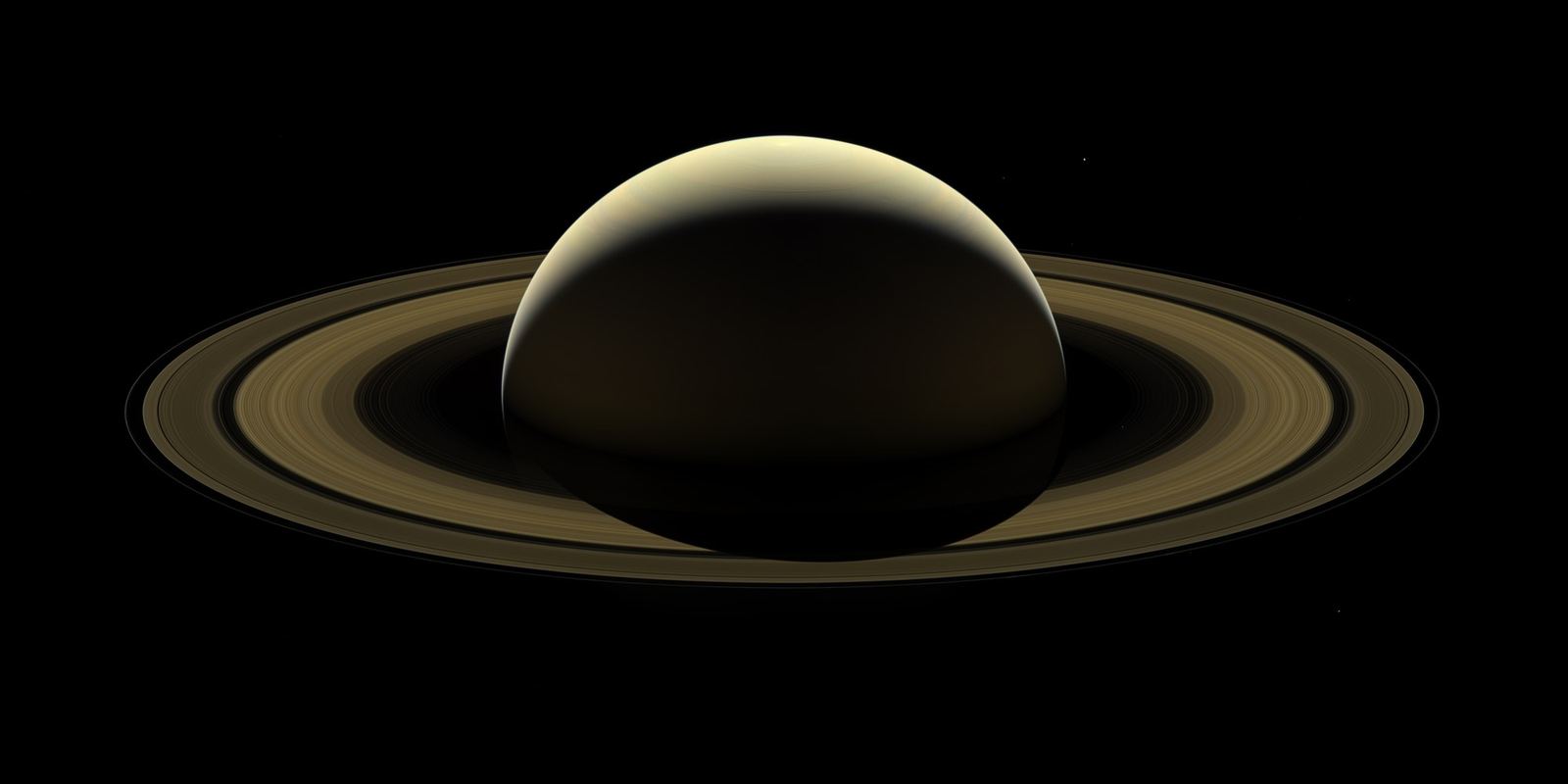
Saturn backlit, seen by Cassini: NASA / JPL-Caltech / Space Science Institute, Public domain
A long road to Saturn
Cassini-Huygens was one of the largest and most complex planetary missions ever built, a partnership between NASA, ESA and the Italian Space Agency. It launched in October 1997 and used gravity assists from Venus, Earth and Jupiter to reach Saturn in 2004.
Discoveries
Over 13 years, Cassini transformed our understanding of Saturn. It discovered the water plumes of Enceladus, mapped Titan's methane seas, watched a giant storm wrap around the planet and studied the hexagon-shaped jet stream at Saturn's north pole. It also found new moons and revealed how moons sculpt the rings.
Huygens
The European Huygens probe separated from Cassini and parachuted through Titan's atmosphere on January 14, 2005. It landed on a plain of rounded ice pebbles and sent data for more than an hour, still the most distant landing ever achieved.
The mission also carried the names of more than 600,000 people on a DVD attached to the spacecraft, so a small piece of many families ended its journey inside Saturn alongside the probe.
The Grand Finale
With fuel running low, the team designed a daring ending. Cassini made 22 orbits diving through the gap between Saturn and its innermost rings, measuring the planet's gravity and the mass of the rings. On September 15, 2017, it plunged into Saturn's atmosphere on purpose, so it could never crash into and contaminate Enceladus or Titan, worlds that might hold life.
A treasure of data
Cassini sent back more than 450,000 images and hundreds of gigabytes of science data, and scientists are still publishing discoveries from it years after the mission ended. Its observations of Enceladus changed planetary science by showing that small moons can host active oceans. Many of the mission concepts now being studied for the outer solar system grew directly out of questions Cassini raised.
Cassini's views of Saturn backlit by the Sun, its rings glowing and Earth visible as a tiny dot, became some of the most admired space images ever taken.
- Saturn backlit, seen by Cassini: NASA / JPL-Caltech / Space Science Institute, Public domain
Text written by Planetinio.