Perseverance Rover

Searching for ancient life on Mars. Perseverance landed in Jezero Crater in 2021 to search for signs of ancient life and collect samples. Its helicopter partner and biggest finds.
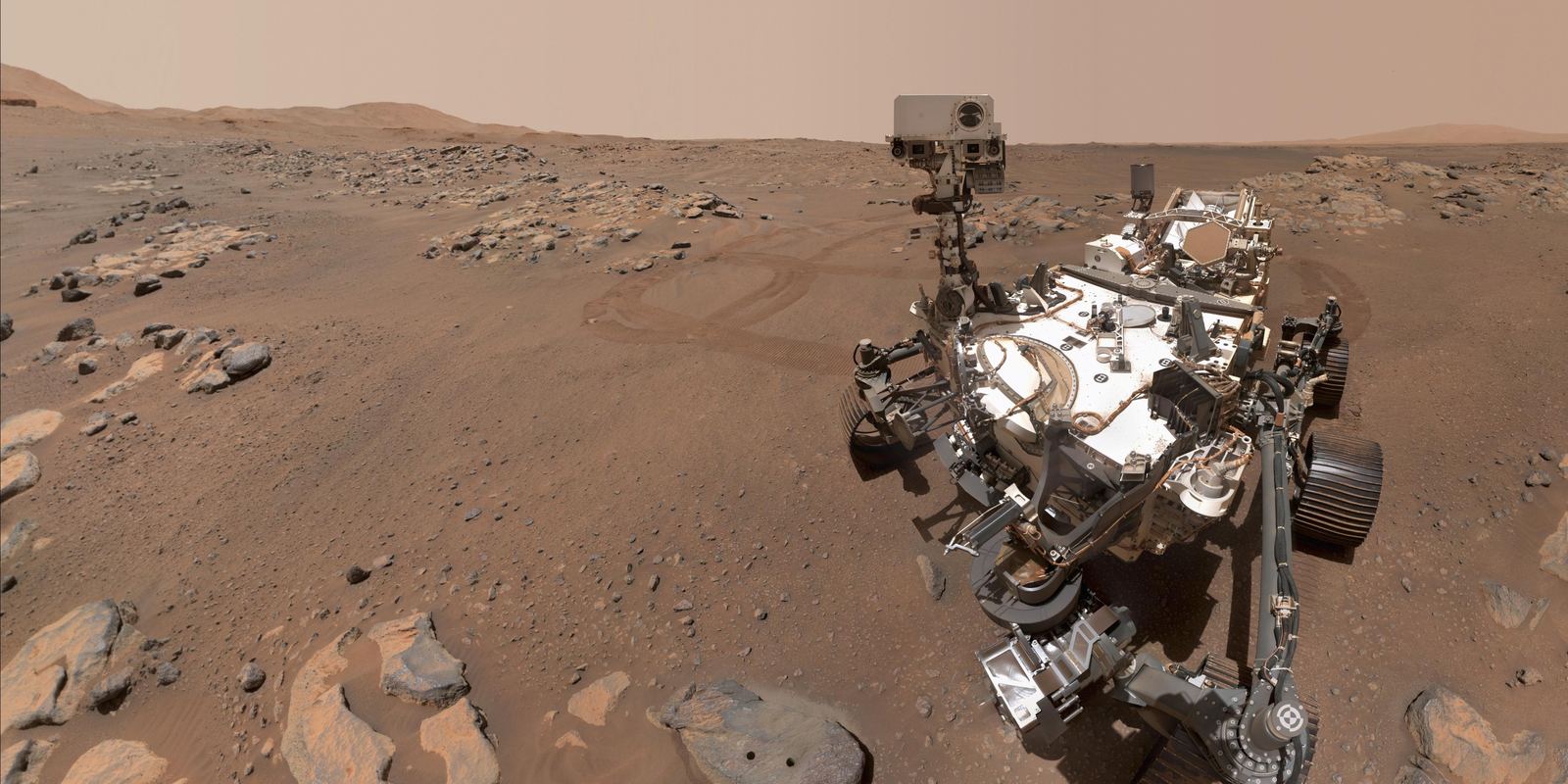
The Perseverance rover taking a selfie next to a rock on Mars

Perseverance's selfie at Rochette: NASA, Public domain

Why Jezero Crater

Perseverance landed in Jezero Crater, which held a lake billions of years ago. A river delta at its edge is the kind of place where, on Earth, sediments preserve traces of microbial life. The rover's mission is to search for signs of ancient life and collect rock samples for possible return to Earth.

A laboratory on wheels

Perseverance carries cameras, a ground-penetrating radar, instruments that use lasers and X-rays to read the chemistry of rocks, and a drill that fills sample tubes. Its MOXIE experiment made oxygen from the carbon dioxide atmosphere, a small test for future human missions.

In 2024 it found a rock nicknamed Cheyava Falls with features that, on Earth, can be linked to microbes. Scientists stress it is a possible biosignature that needs more study, ideally in labs on Earth.

Ingenuity

The rover carried Ingenuity, a 1.8 kg helicopter. On April 19, 2021, it made the first powered, controlled flight on another planet. Planned for five test flights, it flew 72 times before a damaged rotor ended its mission in January 2024.

Perseverance shares its design with Curiosity, which landed in Gale Crater in 2012 and is still exploring, so two nuclear-powered rovers are working on Mars at the same time, in two very different ancient environments.

Sample return

Perseverance has sealed many tubes of rock, soil and air. NASA and ESA have studied how to bring them to Earth, but the plan's cost and timing have been under review, so check NASA for the latest. Either way, Perseverance keeps exploring the crater rim and beyond.

Following along

NASA posts Perseverance's raw images online soon after they arrive, so anyone can browse the latest views from Mars. The rover has more than 20 cameras, and its microphones recorded the first sounds from the Martian surface, including wind and the hum of Ingenuity's rotors. Its route map lets you follow the climb up the crater rim day by day, a reminder that exploration on Mars is slow, careful and full of surprises.

Media credits

Text written by Planetinio.

← JunoJames Webb Space Telescope →

Shop

The Planetinio collection

Tees and hoodies in the Planetinio colors, printed to order in the USA. Use code VIP15 from the newsletter for 15% off your first order.

Watch

Planetinio Shorts

Quick, accurate, under a minute. Every Short is original and made only for this channel.

YouTube @PlanetinioSpace
New Shorts every day. Subscribe so you never miss one.
Subscribe

Latest Shorts

Neptune has the fastest winds in the solar systemPhotos: Neptune Full.jpg - NASA (Public domain) via Wikimedia Commons | Neptune - Voyager 2 (29347980845) flatten crop.jpg - NASA / JPL / Voyager-ISS / Aster Cowart (Public domain) via Wikimedia Commons | Great Dark Spot (cropped).jpg - NASA (Public domain) via Wikimedia Commons | PIA00048 Great Dark Spot and Scooter (cropped).jpg - NASA/JPL (Public domain) via Wikimedia Commons | PIA00063 Neptune - True
Sunsets on Mars are bluePhotos: Carbon dioxide clouds over Mont Mercou, Curiosity Sol 3063 (53100058892).jpg - semeion.photo Credit: NASA/JPL-Caltech/MSSS/Simeon Schmauß (CC BY 2.0) via Wikimedia Commons | Martian-Sunset-O-de-Goursac-Curiosity-2013.jpg - NASA/JPL/MSSS; processings and mosaic: Olivier de Goursac (f (CC BY-SA 3.0) via Wikimedia Commons | Iridescent clouds over Gale Crater (enhanced color) (54302292059).jpg - semei
The Moon is slowly running away from EarthPhotos: Apollo 11 Lunar Laser Ranging Experiment.jpg - NASA (Public domain) via Wikimedia Commons | Laser Ranging Retro-Reflector, Apollo (NASM2020-00367).jpg - Smithsonian National Air and Space Museum/Mark Avino (CC0) via Wikimedia Commons | Lunar Laser Ranging at the Observatoire de la Côte d'Azur DSC 0729 (10782460465).jpg - Melirius (CC BY-SA 2.0) via Wikimedia Commons | ALSEP AS14-67-9386 (cropped).
The planet closest to the Sun has ice on itPhotos: MESSENGER first photo of unseen side of mercury.jpg - NASA/Johns Hopkins University Applied Physics Laboratory/Car (Public domain) via Wikimedia Commons | Mercury in color - Prockter07 centered.jpg - NASA/Johns Hopkins University Applied Physics Laboratory/Car (Public domain) via Wikimedia Commons | Mercury in color - Prockter07-edit1.jpg - National Aeronautics and Space Administration/Johns Hopki
Uranus spins on its side like a rolling ballPhotos: Uranus from Voyager 2.jpg - NASA (Public domain) via Wikimedia Commons | Uranus2.jpg - NASA/JPL-Caltech (Public domain) via Wikimedia Commons | Uranus rings and moons.jpg - Erich Karkoschka (University of Arizona) and NASA/ESA (Public domain) via Wikimedia Commons | Hubble Observes the Planet Uranus (opo9450b).jpg - Kenneth Seidelmann, U.S. Naval Observatory,and NASA/ESA (Public domain) via Wikime
Newsletter

Tonight's sky, monthly

One short email at the start of each month: the Moon phases, the meteor showers worth staying up for and which planets are on show, plus new pages and Shorts.