James Webb Space Telescope

Seeing the first galaxies in infrared. The James Webb Space Telescope launched on Christmas Day 2021 and sees the universe in infrared. Its gold mirror, sunshield and biggest discoveries.
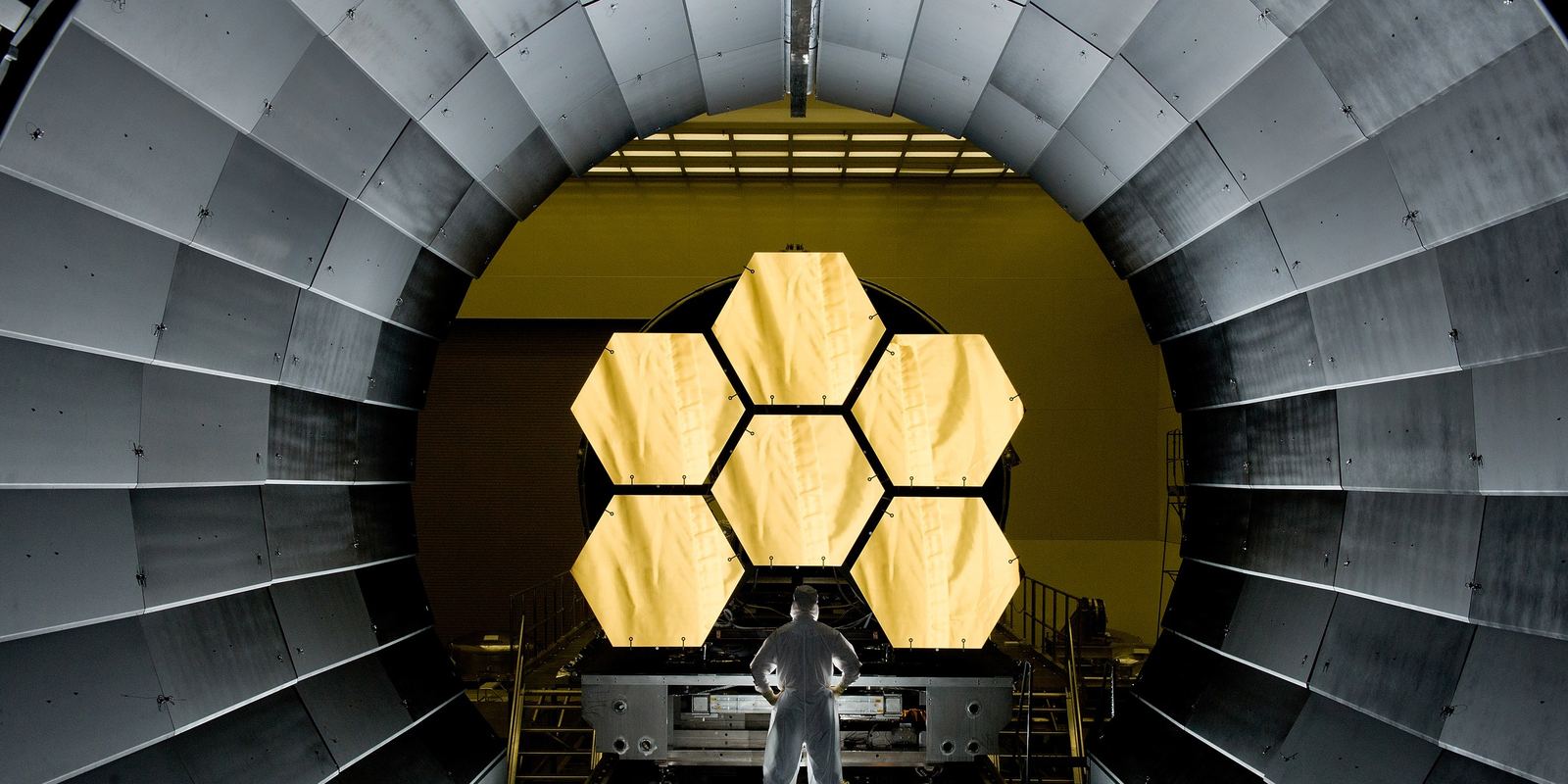
Engineers in clean-room suits in front of Webb's gold hexagonal mirror

Webb's primary mirror being tested: NASA/MSFC/David Higginbotham, Public domain

Hubble's infrared successor

The James Webb Space Telescope is the largest space telescope ever launched. It observes mainly in infrared light, which lets it see through dust clouds where stars form and catch the stretched light of the most distant galaxies, whose light has been travelling for more than 13 billion years.

Unfolding in space

Webb's 6.5-metre mirror was too large to fit in a rocket, so it was folded like origami. After launch on December 25, 2021, it unfolded its five-layer sunshield and mirror segments over several weeks in one of the most complex deployments ever attempted. The sunshield keeps the telescope at about minus 230 degrees Celsius so its own heat does not swamp faint infrared signals.

What Webb has seen

Webb has found galaxies that formed surprisingly early, only a few hundred million years after the Big Bang. It has measured the chemistry of exoplanet atmospheres, detecting carbon dioxide and other molecules, and has taken detailed images of Jupiter, Saturn, Uranus and Neptune with their rings and auroras.

Its images of star-forming regions, like the Pillars of Creation, have become some of the most recognised pictures in science.

Webb is not a replacement for Hubble but a partner. Hubble sees mostly visible and ultraviolet light, while Webb specialises in infrared, and many of the best recent results combine data from both telescopes.

A long life ahead

Webb sits near the Sun-Earth L2 point, about 1.5 million km away. Thanks to a very accurate launch, it saved fuel and could operate for well over a decade. Astronomers worldwide compete for observing time every year, so new discoveries are released constantly.

How to explore Webb's images

NASA, ESA and the Space Telescope Science Institute publish Webb's images with free high resolution downloads and plain-language explanations. Many images come in pairs, showing a target in near and mid infrared, which reveal different layers of dust and gas. Comparing Webb's view of a nebula with Hubble's visible-light picture is a great way to understand why infrared astronomy matters so much.

Media credits
  • Webb's primary mirror being tested: NASA/MSFC/David Higginbotham, Public domain

Text written by Planetinio.
← Perseverance RoverThe Artemis Program →

Shop

The Planetinio collection

Tees and hoodies in the Planetinio colors, printed to order in the USA. Use code VIP15 from the newsletter for 15% off your first order.

Watch

Planetinio Shorts

Quick, accurate, under a minute. Every Short is original and made only for this channel.

YouTube @PlanetinioSpace
New Shorts every day. Subscribe so you never miss one.
Subscribe

Latest Shorts

Neptune has the fastest winds in the solar systemPhotos: Neptune Full.jpg - NASA (Public domain) via Wikimedia Commons | Neptune - Voyager 2 (29347980845) flatten crop.jpg - NASA / JPL / Voyager-ISS / Aster Cowart (Public domain) via Wikimedia Commons | Great Dark Spot (cropped).jpg - NASA (Public domain) via Wikimedia Commons | PIA00048 Great Dark Spot and Scooter (cropped).jpg - NASA/JPL (Public domain) via Wikimedia Commons | PIA00063 Neptune - True
Sunsets on Mars are bluePhotos: Carbon dioxide clouds over Mont Mercou, Curiosity Sol 3063 (53100058892).jpg - semeion.photo Credit: NASA/JPL-Caltech/MSSS/Simeon Schmauß (CC BY 2.0) via Wikimedia Commons | Martian-Sunset-O-de-Goursac-Curiosity-2013.jpg - NASA/JPL/MSSS; processings and mosaic: Olivier de Goursac (f (CC BY-SA 3.0) via Wikimedia Commons | Iridescent clouds over Gale Crater (enhanced color) (54302292059).jpg - semei
The Moon is slowly running away from EarthPhotos: Apollo 11 Lunar Laser Ranging Experiment.jpg - NASA (Public domain) via Wikimedia Commons | Laser Ranging Retro-Reflector, Apollo (NASM2020-00367).jpg - Smithsonian National Air and Space Museum/Mark Avino (CC0) via Wikimedia Commons | Lunar Laser Ranging at the Observatoire de la Côte d'Azur DSC 0729 (10782460465).jpg - Melirius (CC BY-SA 2.0) via Wikimedia Commons | ALSEP AS14-67-9386 (cropped).
The planet closest to the Sun has ice on itPhotos: MESSENGER first photo of unseen side of mercury.jpg - NASA/Johns Hopkins University Applied Physics Laboratory/Car (Public domain) via Wikimedia Commons | Mercury in color - Prockter07 centered.jpg - NASA/Johns Hopkins University Applied Physics Laboratory/Car (Public domain) via Wikimedia Commons | Mercury in color - Prockter07-edit1.jpg - National Aeronautics and Space Administration/Johns Hopki
Uranus spins on its side like a rolling ballPhotos: Uranus from Voyager 2.jpg - NASA (Public domain) via Wikimedia Commons | Uranus2.jpg - NASA/JPL-Caltech (Public domain) via Wikimedia Commons | Uranus rings and moons.jpg - Erich Karkoschka (University of Arizona) and NASA/ESA (Public domain) via Wikimedia Commons | Hubble Observes the Planet Uranus (opo9450b).jpg - Kenneth Seidelmann, U.S. Naval Observatory,and NASA/ESA (Public domain) via Wikime
Newsletter

Tonight's sky, monthly

One short email at the start of each month: the Moon phases, the meteor showers worth staying up for and which planets are on show, plus new pages and Shorts.