The Artemis Program

Returning humans to the Moon. NASA's Artemis program aims to send astronauts back to the Moon. Artemis I, the Artemis II crew, the SLS rocket, Orion and the lunar south pole plans.
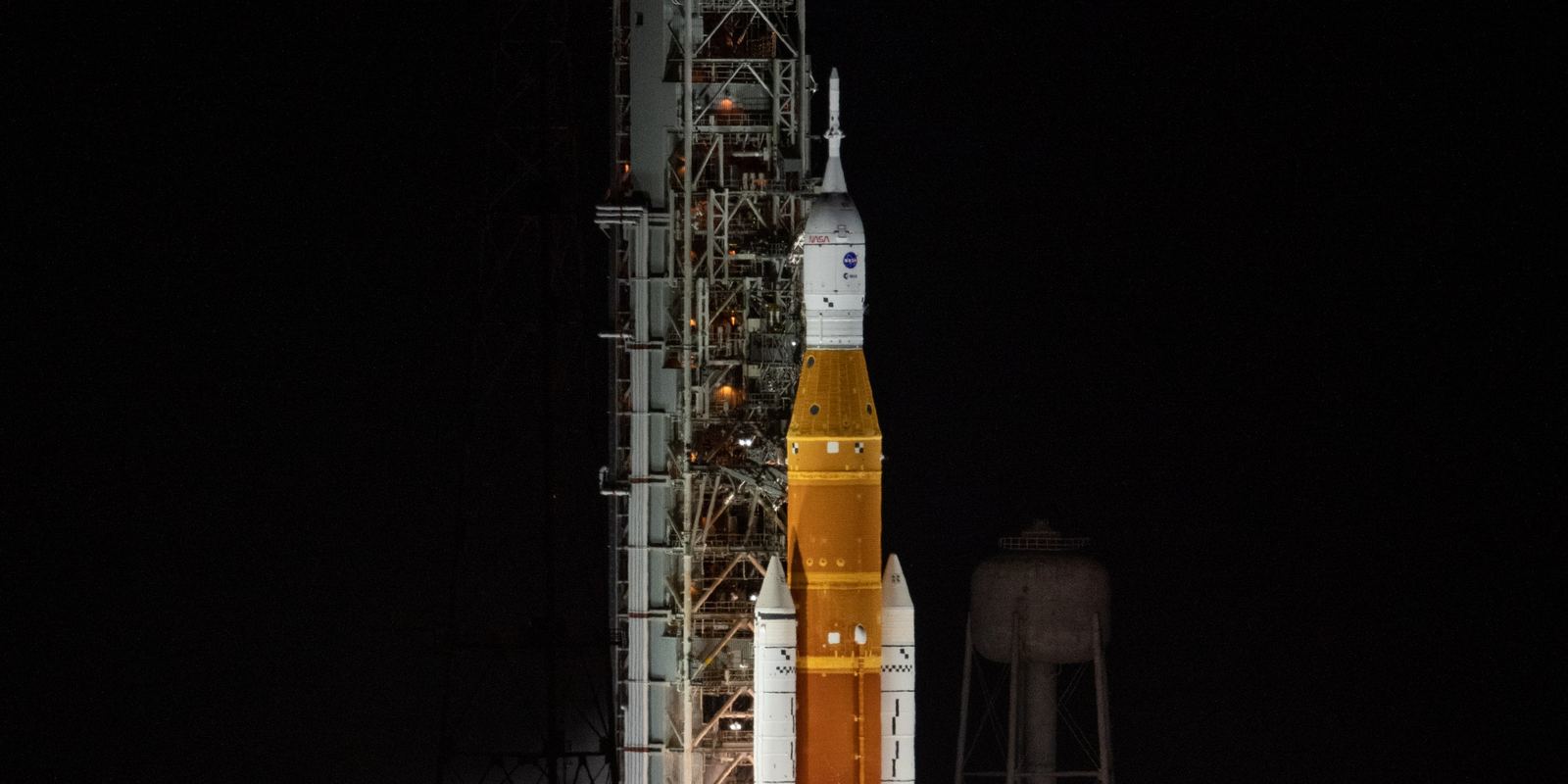
The SLS rocket launching Artemis I at night with a bright flame

Artemis I launch, November 2022: Joel Kowsky, Public domain

Why go back

No human has walked on the Moon since Apollo 17 in December 1972. NASA's Artemis program aims to land astronauts near the lunar south pole, where permanently shadowed craters may hold water ice that future explorers could use for drinking water, air and rocket fuel. The program is international, with partners including the European, Canadian and Japanese space agencies.

Artemis I

On November 16, 2022, the Space Launch System, the most powerful rocket NASA has flown, launched an uncrewed Orion capsule around the Moon. During the 25-day flight, Orion travelled farther from Earth than any spacecraft built to carry humans, then splashed down in the Pacific on December 11, 2022.

Artemis II and beyond

Artemis II is the first crewed flight of the program, a flyby around the Moon with NASA astronauts Reid Wiseman, Victor Glover and Christina Koch and Canadian astronaut Jeremy Hansen. It will make Glover the first person of colour, Koch the first woman and Hansen the first non-American to travel to the Moon.

Later missions plan to land astronauts using commercial landers, and to build a small station in lunar orbit called Gateway. Schedules change often, so check NASA's Artemis page for current dates.

How to follow it

NASA streams launches live on NASA+ and YouTube. From Earth, you can also watch the Moon itself: the south pole region sits at the bottom edge of the Moon as seen from the northern hemisphere, a rugged area of mountains and craters.

Artemis by the numbers

The SLS rocket stands about 98 metres tall in its first version, and at launch it produces about 8.8 million pounds of thrust. Orion's heat shield must survive re-entry at around 40,000 km/h when returning from the Moon, much faster than a return from low Earth orbit. During Artemis I the heat shield lost more material than expected, and engineers studied it closely before flying a crew.

Media credits

Text written by Planetinio.

← James Webb Space TelescopeNew Horizons →

Shop

The Planetinio collection

Tees and hoodies in the Planetinio colors, printed to order in the USA. Use code VIP15 from the newsletter for 15% off your first order.

Watch

Planetinio Shorts

Quick, accurate, under a minute. Every Short is original and made only for this channel.

YouTube @PlanetinioSpace
New Shorts every day. Subscribe so you never miss one.
Subscribe

Latest Shorts

Neptune has the fastest winds in the solar systemPhotos: Neptune Full.jpg - NASA (Public domain) via Wikimedia Commons | Neptune - Voyager 2 (29347980845) flatten crop.jpg - NASA / JPL / Voyager-ISS / Aster Cowart (Public domain) via Wikimedia Commons | Great Dark Spot (cropped).jpg - NASA (Public domain) via Wikimedia Commons | PIA00048 Great Dark Spot and Scooter (cropped).jpg - NASA/JPL (Public domain) via Wikimedia Commons | PIA00063 Neptune - True
Sunsets on Mars are bluePhotos: Carbon dioxide clouds over Mont Mercou, Curiosity Sol 3063 (53100058892).jpg - semeion.photo Credit: NASA/JPL-Caltech/MSSS/Simeon Schmauß (CC BY 2.0) via Wikimedia Commons | Martian-Sunset-O-de-Goursac-Curiosity-2013.jpg - NASA/JPL/MSSS; processings and mosaic: Olivier de Goursac (f (CC BY-SA 3.0) via Wikimedia Commons | Iridescent clouds over Gale Crater (enhanced color) (54302292059).jpg - semei
The Moon is slowly running away from EarthPhotos: Apollo 11 Lunar Laser Ranging Experiment.jpg - NASA (Public domain) via Wikimedia Commons | Laser Ranging Retro-Reflector, Apollo (NASM2020-00367).jpg - Smithsonian National Air and Space Museum/Mark Avino (CC0) via Wikimedia Commons | Lunar Laser Ranging at the Observatoire de la Côte d'Azur DSC 0729 (10782460465).jpg - Melirius (CC BY-SA 2.0) via Wikimedia Commons | ALSEP AS14-67-9386 (cropped).
The planet closest to the Sun has ice on itPhotos: MESSENGER first photo of unseen side of mercury.jpg - NASA/Johns Hopkins University Applied Physics Laboratory/Car (Public domain) via Wikimedia Commons | Mercury in color - Prockter07 centered.jpg - NASA/Johns Hopkins University Applied Physics Laboratory/Car (Public domain) via Wikimedia Commons | Mercury in color - Prockter07-edit1.jpg - National Aeronautics and Space Administration/Johns Hopki
Uranus spins on its side like a rolling ballPhotos: Uranus from Voyager 2.jpg - NASA (Public domain) via Wikimedia Commons | Uranus2.jpg - NASA/JPL-Caltech (Public domain) via Wikimedia Commons | Uranus rings and moons.jpg - Erich Karkoschka (University of Arizona) and NASA/ESA (Public domain) via Wikimedia Commons | Hubble Observes the Planet Uranus (opo9450b).jpg - Kenneth Seidelmann, U.S. Naval Observatory,and NASA/ESA (Public domain) via Wikime
Newsletter

Tonight's sky, monthly

One short email at the start of each month: the Moon phases, the meteor showers worth staying up for and which planets are on show, plus new pages and Shorts.