New Horizons
The first close look at Pluto. New Horizons flew past Pluto in 2015 and the Kuiper Belt object Arrokoth in 2019. The fastest launch, the heart-shaped plain and what came next.
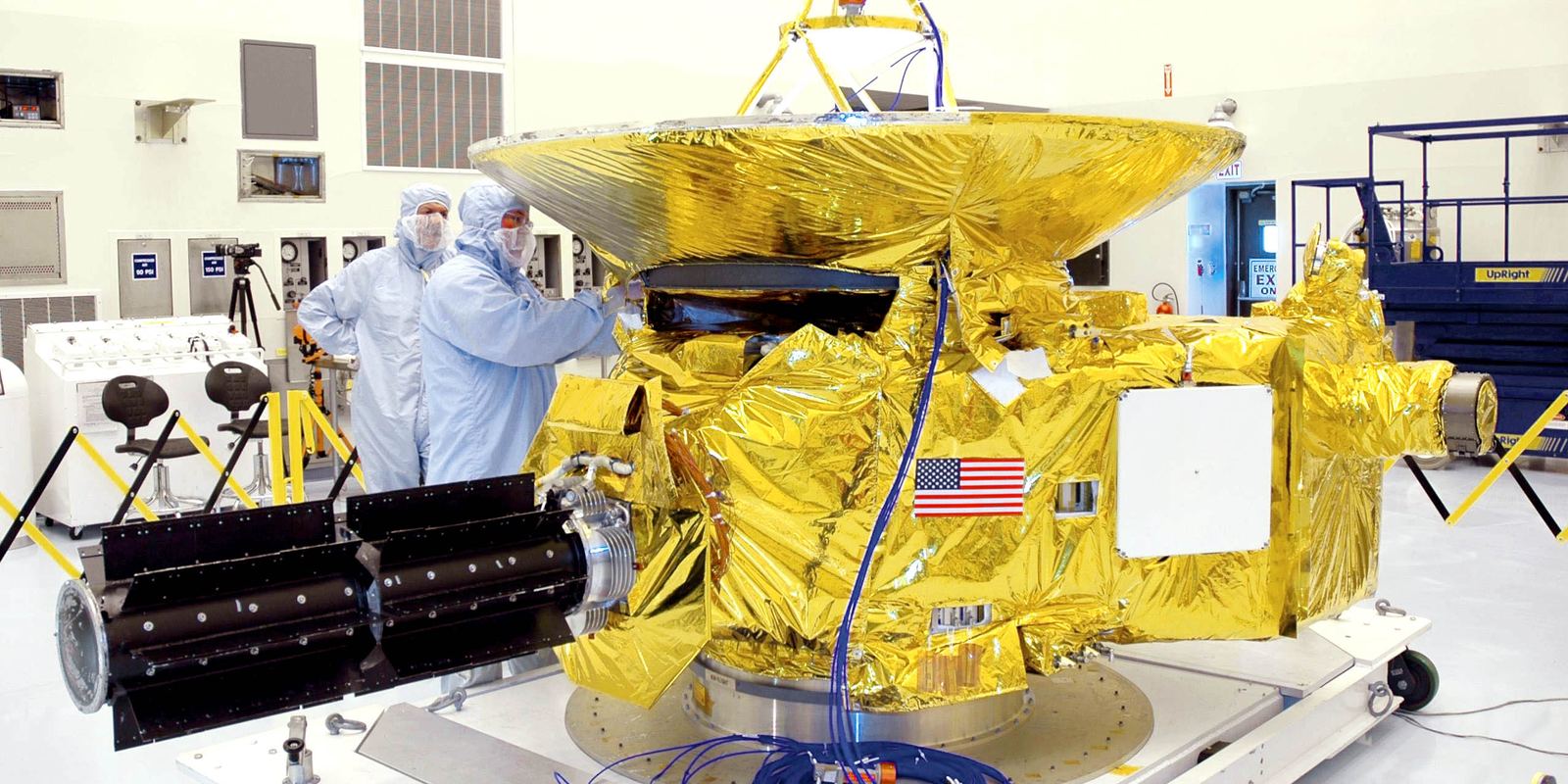
New Horizons before launch: NASA, Public domain
A speedy start
New Horizons left Earth on January 19, 2006 faster than any spacecraft before it, crossing the Moon's orbit in about nine hours. A gravity assist from Jupiter in 2007 shaved years off the trip. When it launched, Pluto was still classed as a planet; months later, it became a dwarf planet.
Pluto revealed
On July 14, 2015, New Horizons flew about 12,500 km above Pluto's surface. It revealed a world of surprises: a vast, heart-shaped plain of nitrogen ice called Sputnik Planitia, water-ice mountains several kilometres high, blue hazes in the atmosphere and signs that Pluto is still geologically active.
It also photographed Charon, Pluto's large moon, with its reddish polar cap.
Arrokoth
On January 1, 2019, New Horizons flew past Arrokoth, a small Kuiper Belt object shaped like two flattened lobes stuck together. It was the most distant object ever explored up close, and its gentle shape suggests planet building blocks formed by slowly merging rather than violent collisions.
The mission was led by planetary scientist Alan Stern and built and operated by the Johns Hopkins University Applied Physics Laboratory for NASA. It cost far less than flagship missions such as Cassini, yet it rewrote the textbooks on Pluto.
Still flying
The spacecraft continues through the Kuiper Belt, studying distant objects and the space environment far from the Sun. On board is a small container holding some of the ashes of Clyde Tombaugh, who discovered Pluto in 1930, making him the first person whose remains are leaving the solar system.
Why it took so long to send the pictures
New Horizons was nearly 5 billion km from Earth at Pluto, and its small radio transmitter could only send data back slowly, roughly a couple of kilobits per second. The spacecraft stored its observations and downloaded them gradually, which took about 15 months. The first sharp photos arrived within days, but scientists kept getting new surprises for more than a year after the flyby.
- New Horizons before launch: NASA, Public domain
Text written by Planetinio.