Parker Solar Probe

Touching the Sun. Parker Solar Probe flies through the Sun's outer atmosphere, closer than any spacecraft. Its heat shield, record speed and what it is learning.
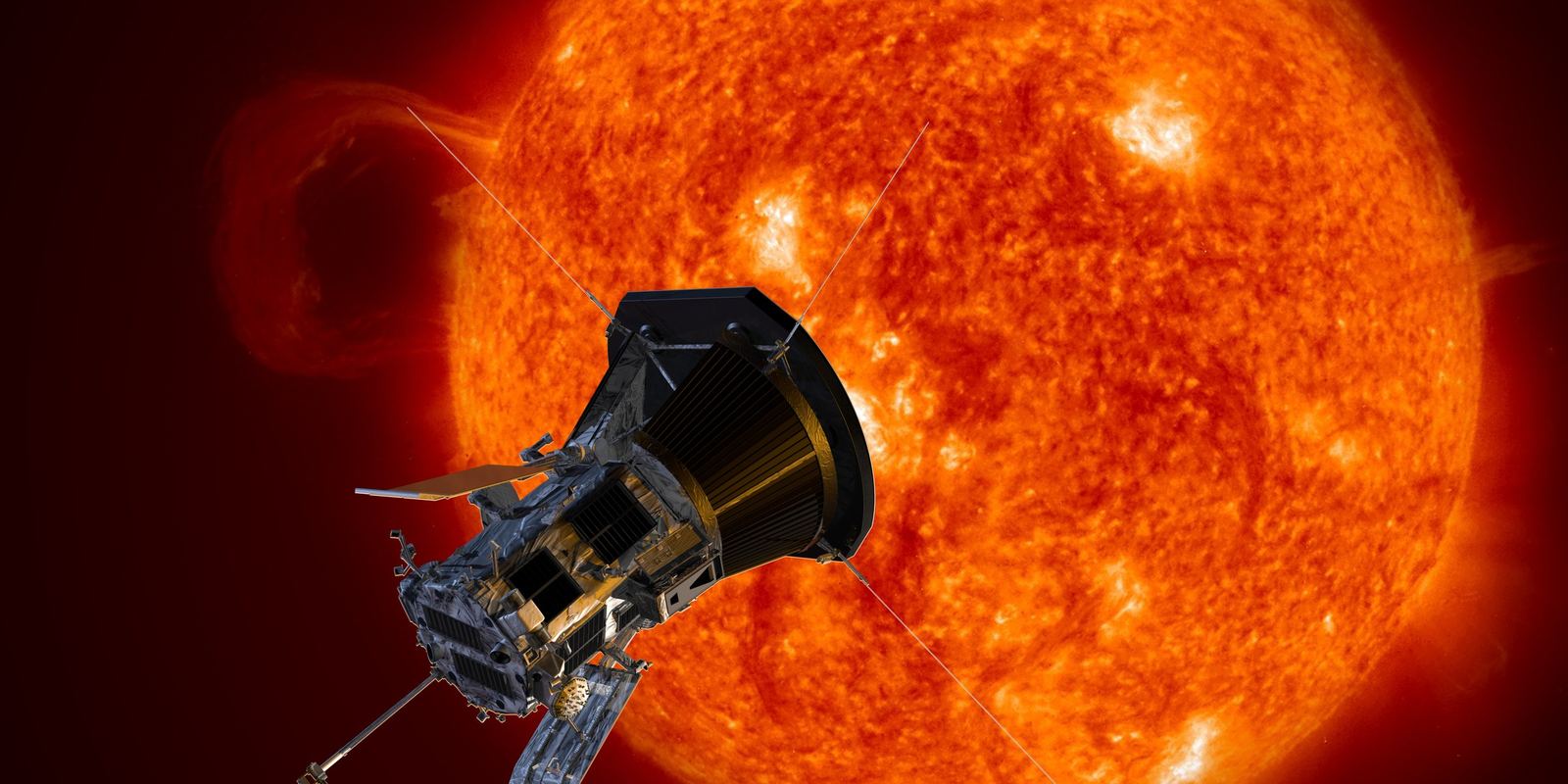
The Parker Solar Probe spacecraft in a clean room with its heat shield

Parker Solar Probe before launch: NASA/Johns Hopkins APL/Steve Gribben, Public domain

Why fly to the Sun

The Sun's outer atmosphere, the corona, is millions of degrees hotter than its visible surface, and nobody fully knows why. The corona also launches the solar wind, a stream of charged particles that fills the solar system and can disturb satellites and power grids on Earth. Parker Solar Probe was built to answer these questions by going there.

Surviving the heat

Parker's front-facing heat shield is 11.4 cm of carbon foam sandwiched between carbon composite sheets, with a white coating to reflect sunlight. On the sunny side it reaches about 1,400 degrees Celsius, while the instruments behind it stay near room temperature. Venus flybys gradually shrank its orbit.

Record breaker

In 2021 Parker became the first spacecraft to fly through the corona. On December 24, 2024, it passed about 6.1 million km from the Sun's surface, at around 692,000 km/h, the fastest any human-made object has travelled. It has discovered magnetic zigzags in the solar wind called switchbacks and traced them to the Sun's surface.

Parker works alongside ESA's Solar Orbiter, launched in 2020, which watches the Sun from a little farther away and photographs its poles. Comparing data from both spacecraft lets scientists trace solar wind streams from their source on the Sun to the space around the planets.

A tribute to a scientist

The probe is named after Eugene Parker, who predicted the solar wind in 1958. It was the first NASA spacecraft named after a living person, and Parker watched its launch in 2018. He died in 2022, after seeing his spacecraft confirm ideas he had proposed decades earlier.

Why it is so fast

Getting close to the Sun is surprisingly hard. Earth, and everything launched from it, already moves sideways around the Sun at about 30 km per second, and a spacecraft must cancel most of that motion to fall inward. Parker uses repeated Venus flybys to slow its orbital motion, which lets it fall closer each time. As it drops toward the Sun it speeds up enormously, like a skater pulling in their arms.

Media credits
  • Parker Solar Probe before launch: NASA/Johns Hopkins APL/Steve Gribben, Public domain

Text written by Planetinio.
← New HorizonsEuropa Clipper →

Shop

The Planetinio collection

Tees and hoodies in the Planetinio colors, printed to order in the USA. Use code VIP15 from the newsletter for 15% off your first order.

Watch

Planetinio Shorts

Quick, accurate, under a minute. Every Short is original and made only for this channel.

YouTube @PlanetinioSpace
New Shorts every day. Subscribe so you never miss one.
Subscribe

Latest Shorts

Neptune has the fastest winds in the solar systemPhotos: Neptune Full.jpg - NASA (Public domain) via Wikimedia Commons | Neptune - Voyager 2 (29347980845) flatten crop.jpg - NASA / JPL / Voyager-ISS / Aster Cowart (Public domain) via Wikimedia Commons | Great Dark Spot (cropped).jpg - NASA (Public domain) via Wikimedia Commons | PIA00048 Great Dark Spot and Scooter (cropped).jpg - NASA/JPL (Public domain) via Wikimedia Commons | PIA00063 Neptune - True
Sunsets on Mars are bluePhotos: Carbon dioxide clouds over Mont Mercou, Curiosity Sol 3063 (53100058892).jpg - semeion.photo Credit: NASA/JPL-Caltech/MSSS/Simeon Schmauß (CC BY 2.0) via Wikimedia Commons | Martian-Sunset-O-de-Goursac-Curiosity-2013.jpg - NASA/JPL/MSSS; processings and mosaic: Olivier de Goursac (f (CC BY-SA 3.0) via Wikimedia Commons | Iridescent clouds over Gale Crater (enhanced color) (54302292059).jpg - semei
The Moon is slowly running away from EarthPhotos: Apollo 11 Lunar Laser Ranging Experiment.jpg - NASA (Public domain) via Wikimedia Commons | Laser Ranging Retro-Reflector, Apollo (NASM2020-00367).jpg - Smithsonian National Air and Space Museum/Mark Avino (CC0) via Wikimedia Commons | Lunar Laser Ranging at the Observatoire de la Côte d'Azur DSC 0729 (10782460465).jpg - Melirius (CC BY-SA 2.0) via Wikimedia Commons | ALSEP AS14-67-9386 (cropped).
The planet closest to the Sun has ice on itPhotos: MESSENGER first photo of unseen side of mercury.jpg - NASA/Johns Hopkins University Applied Physics Laboratory/Car (Public domain) via Wikimedia Commons | Mercury in color - Prockter07 centered.jpg - NASA/Johns Hopkins University Applied Physics Laboratory/Car (Public domain) via Wikimedia Commons | Mercury in color - Prockter07-edit1.jpg - National Aeronautics and Space Administration/Johns Hopki
Uranus spins on its side like a rolling ballPhotos: Uranus from Voyager 2.jpg - NASA (Public domain) via Wikimedia Commons | Uranus2.jpg - NASA/JPL-Caltech (Public domain) via Wikimedia Commons | Uranus rings and moons.jpg - Erich Karkoschka (University of Arizona) and NASA/ESA (Public domain) via Wikimedia Commons | Hubble Observes the Planet Uranus (opo9450b).jpg - Kenneth Seidelmann, U.S. Naval Observatory,and NASA/ESA (Public domain) via Wikime
Newsletter

Tonight's sky, monthly

One short email at the start of each month: the Moon phases, the meteor showers worth staying up for and which planets are on show, plus new pages and Shorts.