Europa Clipper

NASA's largest planetary spacecraft. Europa Clipper launched in 2024 to study Jupiter's ocean moon Europa. Its giant solar arrays, instruments, flight path and arrival in 2030.
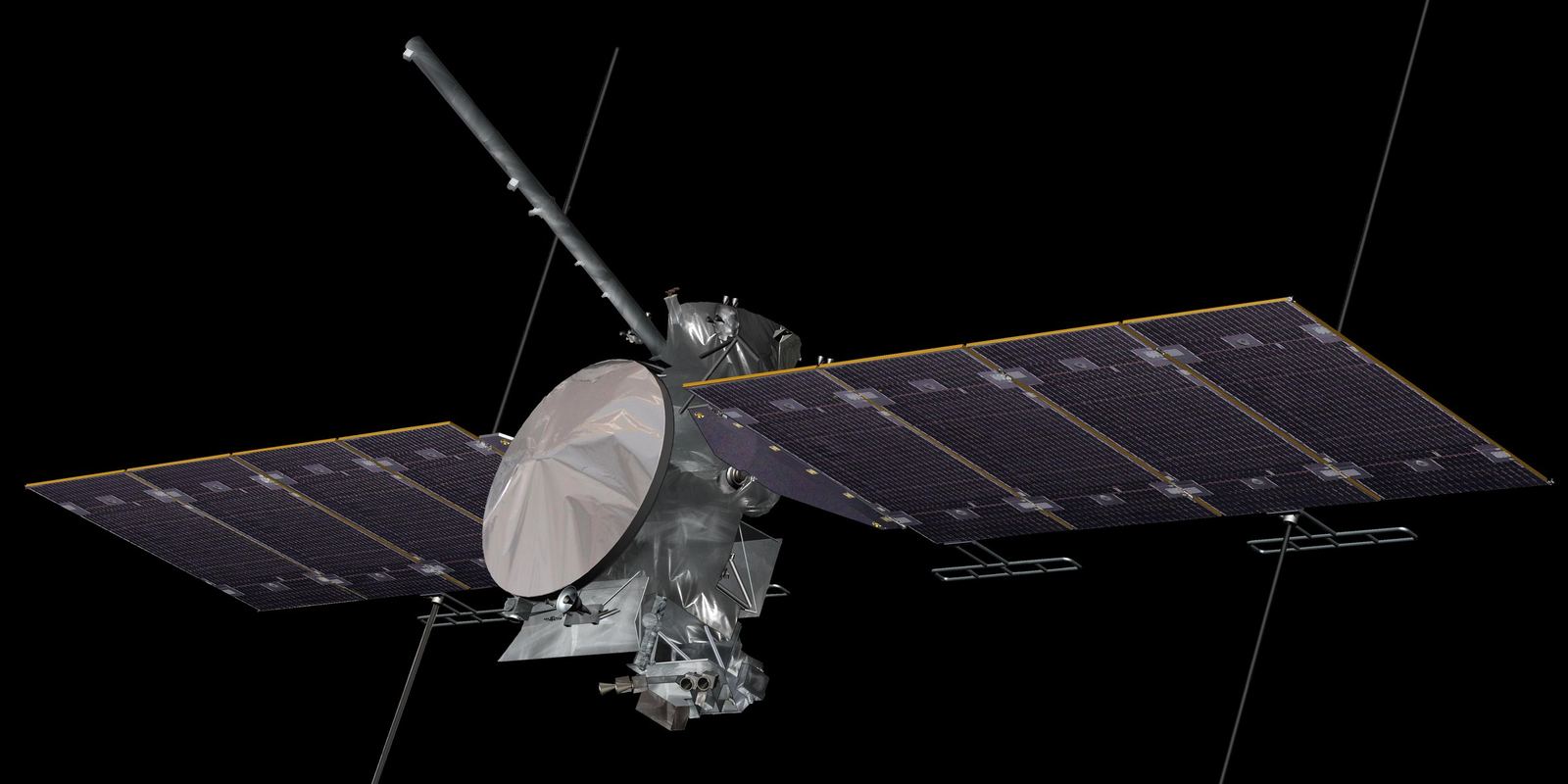
Model of the Europa Clipper spacecraft with long solar arrays

Europa Clipper (model): National Aeronautics and Space Administration (NASA) · Jet Propulsion Laboratory, Public domain

The mission

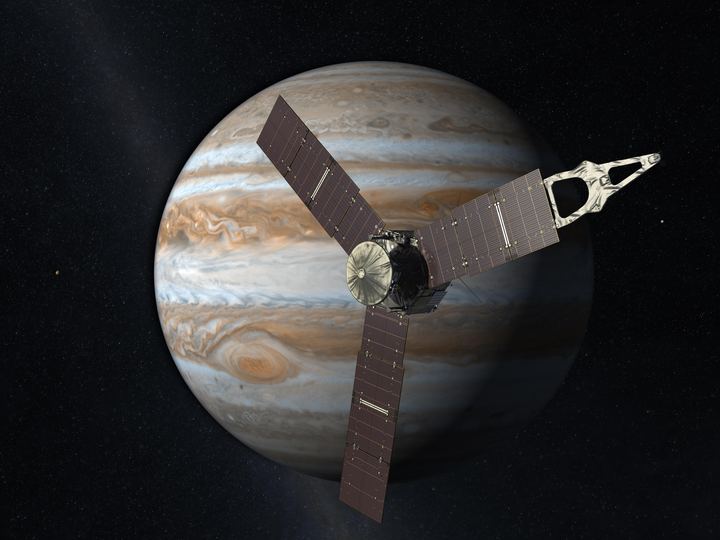
Europa Clipper is designed to find out whether Europa, a moon of Jupiter, could support life. It launched from Kennedy Space Center on October 14, 2024, aboard a SpaceX Falcon Heavy. It is NASA's largest spacecraft ever built for a planetary mission.

A long, looping trip

To gain speed, Clipper flew past Mars in March 2025 and returns past Earth in December 2026 before heading to Jupiter, arriving in April 2030. Rather than orbiting Europa, where radiation is intense, it will orbit Jupiter and swoop past Europa about 49 times, sometimes passing just 25 km above the surface.

What it carries

Clipper carries cameras, an ice-penetrating radar to measure the thickness of the ice shell, a magnetometer to confirm the ocean, a thermal instrument to find warm spots, and mass spectrometers to sniff any plumes or particles thrown off the surface. Its electronics sit in a radiation-shielded vault.

It also carries a vault plate engraved with a poem by US Poet Laureate Ada Limon and waveforms of the word water in more than 100 languages.

Clipper's high-gain antenna is about 3 metres across, and its data will travel the long way home to NASA's Deep Space Network dishes in California, Spain and Australia, which keep in touch with spacecraft across the solar system.

Working with JUICE

ESA's JUICE mission, launched in 2023, will arrive at Jupiter in 2031 and focus on Ganymede. Together, the two spacecraft will give the most complete picture yet of Jupiter's icy moons and their hidden oceans.

How Clipper is protected

Jupiter's radiation belts are among the harshest environments in the solar system. Clipper's sensitive electronics sit inside a vault with walls of aluminium and zinc, designed to slow the damage. Each flyby is short, followed by a long swing away from Jupiter to transmit data and limit radiation exposure. Engineers expect the mission to survive several years of these passes, gathering enough data to judge Europa's habitability.

Media credits
  • Europa Clipper (model): National Aeronautics and Space Administration (NASA) · Jet Propulsion Laboratory, Public domain

Text written by Planetinio.
← Parker Solar ProbeThe Sun →

Shop

The Planetinio collection

Tees and hoodies in the Planetinio colors, printed to order in the USA. Use code VIP15 from the newsletter for 15% off your first order.

Watch

Planetinio Shorts

Quick, accurate, under a minute. Every Short is original and made only for this channel.

YouTube @PlanetinioSpace
New Shorts every day. Subscribe so you never miss one.
Subscribe

Latest Shorts

Neptune has the fastest winds in the solar systemPhotos: Neptune Full.jpg - NASA (Public domain) via Wikimedia Commons | Neptune - Voyager 2 (29347980845) flatten crop.jpg - NASA / JPL / Voyager-ISS / Aster Cowart (Public domain) via Wikimedia Commons | Great Dark Spot (cropped).jpg - NASA (Public domain) via Wikimedia Commons | PIA00048 Great Dark Spot and Scooter (cropped).jpg - NASA/JPL (Public domain) via Wikimedia Commons | PIA00063 Neptune - True
Sunsets on Mars are bluePhotos: Carbon dioxide clouds over Mont Mercou, Curiosity Sol 3063 (53100058892).jpg - semeion.photo Credit: NASA/JPL-Caltech/MSSS/Simeon Schmauß (CC BY 2.0) via Wikimedia Commons | Martian-Sunset-O-de-Goursac-Curiosity-2013.jpg - NASA/JPL/MSSS; processings and mosaic: Olivier de Goursac (f (CC BY-SA 3.0) via Wikimedia Commons | Iridescent clouds over Gale Crater (enhanced color) (54302292059).jpg - semei
The Moon is slowly running away from EarthPhotos: Apollo 11 Lunar Laser Ranging Experiment.jpg - NASA (Public domain) via Wikimedia Commons | Laser Ranging Retro-Reflector, Apollo (NASM2020-00367).jpg - Smithsonian National Air and Space Museum/Mark Avino (CC0) via Wikimedia Commons | Lunar Laser Ranging at the Observatoire de la Côte d'Azur DSC 0729 (10782460465).jpg - Melirius (CC BY-SA 2.0) via Wikimedia Commons | ALSEP AS14-67-9386 (cropped).
The planet closest to the Sun has ice on itPhotos: MESSENGER first photo of unseen side of mercury.jpg - NASA/Johns Hopkins University Applied Physics Laboratory/Car (Public domain) via Wikimedia Commons | Mercury in color - Prockter07 centered.jpg - NASA/Johns Hopkins University Applied Physics Laboratory/Car (Public domain) via Wikimedia Commons | Mercury in color - Prockter07-edit1.jpg - National Aeronautics and Space Administration/Johns Hopki
Uranus spins on its side like a rolling ballPhotos: Uranus from Voyager 2.jpg - NASA (Public domain) via Wikimedia Commons | Uranus2.jpg - NASA/JPL-Caltech (Public domain) via Wikimedia Commons | Uranus rings and moons.jpg - Erich Karkoschka (University of Arizona) and NASA/ESA (Public domain) via Wikimedia Commons | Hubble Observes the Planet Uranus (opo9450b).jpg - Kenneth Seidelmann, U.S. Naval Observatory,and NASA/ESA (Public domain) via Wikime
Newsletter

Tonight's sky, monthly

One short email at the start of each month: the Moon phases, the meteor showers worth staying up for and which planets are on show, plus new pages and Shorts.